Market Briefing
Fav
Daily Pulse
Weekly Pulse
IBKR
Sentiment
Misc
Manufacturing PMI
This is a digest, see original post for details.
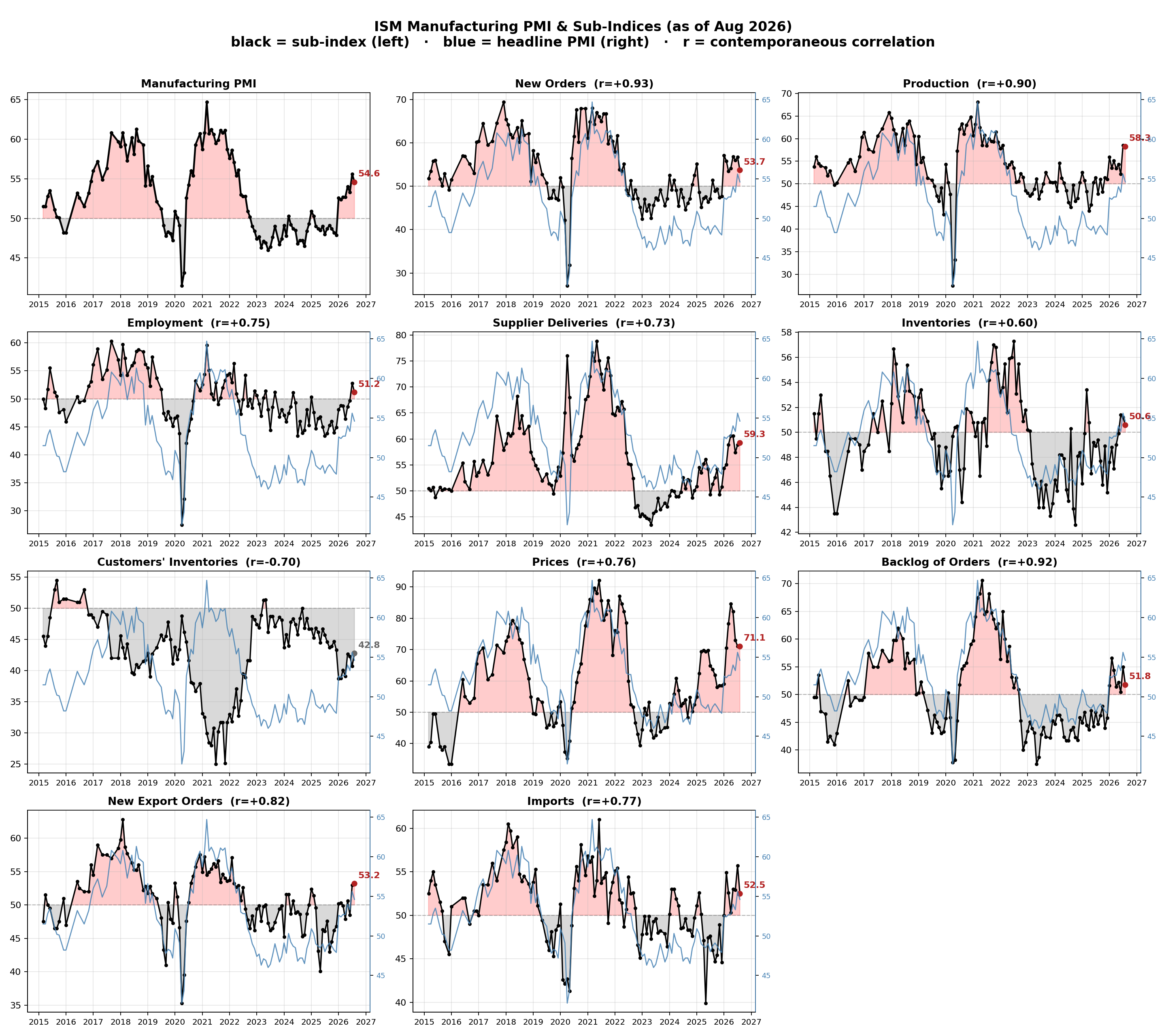
ISM Manufacturing PMI — August 2026
Headline: The PMI fell 1.0 point to 54.6, but manufacturing continued to expand for an eighth consecutive month, at a slower rate. The reading was above the trailing six-month average of 53.4 and remained within the 52.4–55.6 six-month range. It also indicates a growing broader economy, comfortably above the 47.5 breakeven level.
Sub-indices:
| Index | Level | Prior | Change | Direction | vs 6-mo |
|---|---|---|---|---|---|
| New Orders | 53.7 | 56.7 | -3.0 | Growing | above avg (55.5) |
| Production | 58.3 | 58.5 | -0.2 | Growing | above avg (54.5) |
| Employment | 51.2 | 52.8 | -1.6 | Growing | above avg (49.2) |
| Supplier Deliveries | 59.3 | 58.9 | +0.4 | Slowing | above avg (58.6) |
| Inventories | 50.6 | 51.2 | -0.6 | Growing | above avg (49.6) |
| Customers' Inventories | 42.8 | 40.7 | +2.1 | Too Low | 6-mo high |
| Prices | 71.1 | 71.1 | 0.0 | Increasing | below avg (76.6) |
| Backlog of Orders | 51.8 | 55.0 | -3.2 | Growing | below avg (53.4) |
| New Export Orders | 53.2 | 53.0 | +0.2 | Growing | 6-mo high |
| Imports | 52.5 | 55.7 | -3.2 | Growing | below avg (53.2) |
Key moves:
- Customers’ Inventories rose to 42.8, a six-month high, but remained well below 50, indicating inventories at customers are still too low.
- New Export Orders reached a six-month high of 53.2, while New Orders fell to 53.7, below its six-month average of 55.5.
- Backlog of Orders declined 3.2 points to 51.8, below its six-month average, while Prices held at 71.1, below the six-month average of 76.6.
Insights:
- Current production remains a clear support at 58.3, well above its six-month average, but the forward demand profile softened: New Orders fell to 53.7 and Backlog to 51.8. This points to continued expansion with less momentum behind future output.
- The 50.6 Inventories reading is only marginally expansionary. With New Orders and Backlogs weakening, the modest inventory level is more consistent with caution around demand than deliberate stocking for a stronger order pipeline.
- Customers’ Inventories remain “Too Low” at 42.8, a bullish reorder signal despite the monthly increase. This provides some offset to the softer domestic order and backlog readings.
- Supplier Deliveries at 59.3 indicate slower deliveries and are above their six-month average, consistent with ongoing demand or supply-chain tightness rather than broad manufacturing slack.
- Prices remained elevated at 71.1 for a 23rd month, sustaining input-cost pressure. Although below the recent six-month average, the level remains a material margin and goods-inflation risk.
Breadth & prices: All 15 industries reported growth and none reported contraction. Input prices continued increasing, with the Prices Index unchanged at 71.1.
Takeaway: August confirms an expanding manufacturing cycle, with production and export demand resilient but domestic orders and backlogs losing momentum. Low customer inventories and continued delivery constraints support near-term activity, while elevated prices and a softer forward-order profile argue for slower growth with persistent margin pressure.
This content is for informational purposes only and does not constitute financial, investment, or trading advice. Always consult a qualified financial professional before making any investment decisions.
Manufacturing PMI
This is a digest, see original post for details.
ISM Manufacturing PMI — July 2026
Headline: The Manufacturing PMI rose to 55.6 from 53.3 (+2.3), indicating manufacturing expansion at a faster rate for the seventh consecutive month. The reading was a 6-month high, well above the prior six-month average of 52.9 and above the 52.4–54.0 range. At 55.6, the index is above both the manufacturing breakeven of 50.0 and the broader-economy breakeven of 47.5, consistent with expansion in manufacturing and the overall economy.
Sub-indices:
| Index | Level | Prior | Change | Direction | vs 6-mo |
|---|---|---|---|---|---|
| New Orders | 56.7 | 56.0 | +0.7 | Growing | above avg (55.6) |
| Production | 58.5 | 52.2 | +6.3 | Growing | 6-mo high |
| Employment | 52.8 | 49.7 | +3.1 | Growing | 6-mo high |
| Supplier Deliveries | 58.9 | 57.4 | +1.5 | Slowing | above avg (57.8) |
| Inventories | 51.2 | 51.4 | -0.2 | Growing | above avg (49.0) |
| Customers' Inventories | 40.7 | 42.3 | -1.6 | Too Low | above avg (40.3) |
| Prices | 71.1 | 73.0 | -1.9 | Increasing | below avg (74.6) |
| Backlog of Orders | 55.0 | 50.5 | +4.5 | Growing | above avg (52.8) |
| New Export Orders | 53.0 | 48.5 | +4.5 | Growing | 6-mo high |
| Imports | 55.7 | 52.9 | +2.8 | Growing | 6-mo high |
Key moves:
- Production surged 6.3 points to 58.5, a six-month high and well above its prior six-month range of 52.2–55.9.
- Employment rose 3.1 points to 52.8, its six-month high, crossing above 50 from 49.7 in June.
- New Export Orders and Imports both reached six-month highs; export orders rose above 50 from 48.5, while Backlog of Orders increased to 55.0, above its six-month average.
Insights:
- The demand backdrop strengthened: New Orders at 56.7, Backlog at 55.0, and customers’ inventories at 40.7 (“too low”) point to a favorable reorder pipeline and support for future production.
- The modest 51.2 reading for manufacturers’ inventories, alongside rising orders and backlogs, looks more consistent with measured, demand-supported stocking than an involuntary buildup.
- Supplier Deliveries at 58.9 indicate slower deliveries, consistent with stronger demand and/or supply tightness rather than slack. The combination of six-month highs in Production, Employment and Imports suggests the expansion is broadening.
- Input-cost pressure remains material: Prices at 71.1 still signal rising costs, although the index is below its six-month average of 74.6 and has eased for a second month.
Breadth & prices: All 15 reported industries indicated growth, while zero reported contraction. Input prices continued to increase, with the Prices Index at 71.1, albeit at a slower rate than in June.
Takeaway: July’s report signals a firmer manufacturing cycle, with demand, production, labor and external activity all improving and the headline PMI reaching a six-month high. Low customer inventories and expanding backlogs support continued near-term output, while elevated input prices and slower supplier deliveries remain constraints.
This content is for informational purposes only and does not constitute financial, investment, or trading advice. Always consult a qualified financial professional before making any investment decisions.
Manufacturing PMI
This is a digest, see original post for details.
ISM Manufacturing PMI — June 2026
Headline: The Manufacturing PMI fell 0.7 point to 53.3, indicating continued expansion at a slower rate for the sixth consecutive month. The reading was above its trailing six-month average of 52.1 and within the prior six-month range of 47.9–54.0. At 53.3, manufacturing remained above its 50.0 breakeven level and the 47.5 threshold associated with broader-economy growth.
Sub-indices:
| Index | Level | Prior | Change | Direction | vs 6-mo |
|---|---|---|---|---|---|
| New Orders | 56.0 | 56.8 | -0.8 | Growing | above avg (54.2) |
| Production | 52.2 | 54.3 | -2.1 | Growing | below avg (53.9) |
| Employment | 49.7 | 48.6 | +1.1 | Contracting | 6-mo high |
| Supplier Deliveries | 57.4 | 60.6 | -3.2 | Slowing | above avg (56.7) |
| Inventories | 51.4 | 49.9 | +1.5 | Growing | 6-mo high |
| Customers' Inventories | 42.3 | 42.7 | -0.4 | Too Low | above avg (40.4) |
| Prices | 73.0 | 82.1 | -9.1 | Increasing | above avg (72.2) |
| Backlog of Orders | 50.5 | 52.2 | -1.7 | Growing | below avg (52.0) |
| New Export Orders | 48.5 | 50.6 | -2.1 | Contracting | below avg (49.3) |
| Imports | 52.9 | 53.0 | -0.1 | Growing | above avg (50.9) |
Key moves:
- Inventories rose into expansion at 51.4, a six-month high, from 49.9 in May.
- Employment improved to a six-month high of 49.7 but remained below 50, so manufacturing payrolls were still contracting.
- New Export Orders fell below 50 to 48.5, crossing from growth into contraction; Production also weakened to 52.2, below its six-month average.
Insights:
- The inventory build is not purely a weak-demand signal: New Orders remain solid at 56.0, well above their six-month average, while Customers’ Inventories remain too low at 42.3, a constructive setup for replenishment demand. However, the 50.5 Backlog reading and its decline below the six-month average argue against an unequivocally strong forward-production signal.
- Employment shows a clear level/change divergence: the index improved 1.1 points and reached a six-month high, but at 49.7 it still indicates net manufacturing job shedding.
- Supplier Deliveries at 57.4 still signal slower deliveries, consistent with ongoing demand or supply-chain tightness, although the sharp decline from 60.6 suggests that this pressure eased materially in June.
- Input-cost pressure remains elevated: Prices registered 73.0, above the six-month average of 72.2, implying continued margin and goods-inflation risk despite the 9.1-point monthly moderation.
- External demand weakened as New Export Orders contracted, while Imports remained expansionary at 52.9. The combination points to softer global demand even as domestic order flow remains supportive.
Breadth & prices: Growth was reported across 14 industries, with no industries contracting. Input prices continued to increase, with the Prices Index at 73.0, albeit at a slower rate than in May.
Takeaway: June confirms an ongoing but moderating manufacturing expansion: domestic orders and low customer inventories support the cycle, while softer production, backlogs and exports point to slower momentum ahead. Elevated input costs remain the principal macro and margin risk, even with some month-to-month relief.
This content is for informational purposes only and does not constitute financial, investment, or trading advice. Always consult a qualified financial professional before making any investment decisions.
Manufacturing PMI
This is a digest, see original post for details.
ISM Manufacturing PMI — May 2026
Headline: The Manufacturing PMI rose 1.3 points to 54.0 in May, signaling expansion at a faster rate for the fifth consecutive month. The reading was a six-month high, well above the prior six-month average of 51.1 and the 47.9–52.7 range. It remains above the manufacturing breakeven of 50.0; the broader economy also continued to grow, marking its 19th consecutive month above its 47.5 breakeven.
Sub-indices:
| Index | Level | Prior | Change | Direction | vs 6-mo |
|---|---|---|---|---|---|
| New Orders | 56.8 | 54.1 | +2.7 | Growing | above avg (52.6) |
| Production | 54.3 | 53.4 | +0.9 | Growing | above avg (53.4) |
| Employment | 48.6 | 46.4 | +2.2 | Contracting | above avg (46.8) |
| Supplier Deliveries | 60.6 | 60.6 | 0.0 | Slowing | above avg (54.9) |
| Inventories | 49.9 | 49.0 | +0.9 | Contracting | 6-mo high |
| Customers' Inventories | 42.7 | 39.1 | +3.6 | Too Low | above avg (40.8) |
| Prices | 82.1 | 84.6 | -2.5 | Increasing | above avg (68.2) |
| Backlog of Orders | 52.2 | 51.4 | +0.8 | Growing | above avg (50.6) |
| New Export Orders | 50.6 | 47.9 | +2.7 | Growing | 6-mo high |
| Imports | 53.0 | 50.3 | +2.7 | Growing | above avg (50.2) |
Key moves:
- The headline PMI reached a six-month high, supported by New Orders at 56.8, up 2.7 points and above its six-month average.
- New Export Orders crossed above 50 to 50.6, a six-month high, from 47.9 in April.
- Inventories rose to 49.9, also a six-month high, while remaining marginally in contraction; Employment improved but stayed below 50 at 48.6.
Insights:
- The demand picture strengthened materially: New Orders accelerated to 56.8, Backlog of Orders rose to 52.2, and Production remained firmly expansionary at 54.3. The combination points to continued production support in coming months.
- Customers’ Inventories remained “Too Low” at 42.7, a bullish forward-demand signal under ISM methodology, as customers may need to replenish stocks. The improvement from 39.1 does not remove the underlying reorder support.
- The rise in manufacturers’ Inventories to 49.9 occurred alongside stronger New Orders and Backlogs, making the move more consistent with reduced destocking or deliberate preparation for demand than an involuntary buildup. The inventory index nevertheless remains just below 50.
- Employment improved by 2.2 points but remained in contraction, an important divergence from the broader expansion in orders and production. Manufacturing output is strengthening without yet translating into net job growth.
- Supplier Deliveries stayed elevated at 60.6, indicating slower deliveries and continued demand or supply-chain tightness. Prices remained highly inflationary at 82.1, despite easing from 84.6, implying ongoing input-cost and margin pressure.
Breadth & prices: Growth was broad-based, with 16 industries reporting expansion and none contracting. Input prices continued to increase, although the Prices index eased 2.5 points to 82.1.
Takeaway: May’s print confirms a firmer manufacturing upswing, with the PMI at a six-month high and forward-demand indicators strengthening. The cycle remains constructive, but persistent input-cost pressure, delivery constraints and sub-50 employment temper the quality of the expansion.
This content is for informational purposes only and does not constitute financial, investment, or trading advice. Always consult a qualified financial professional before making any investment decisions.
Manufacturing PMI
This is a digest, see original post for details.
ISM Manufacturing PMI — April 2026
Headline: The ISM Manufacturing PMI was 52.7 in April, unchanged from March, indicating manufacturing expanded for a fourth consecutive month. The reading matches the top of its prior six-month range (47.9–52.7) and is above the six-month average of 50.4. It also remains above the manufacturing breakeven of 50.0 and the broader-economy breakeven of 47.5, consistent with growth in both manufacturing and the overall economy.
Sub-indices:
| Index | Level | Prior | Change | Direction | vs 6-mo |
|---|---|---|---|---|---|
| New Orders | 54.1 | 53.5 | +0.6 | Growing | above avg (51.8) |
| Production | 53.4 | 55.1 | -1.7 | Growing | above avg (52.5) |
| Employment | 46.4 | 48.7 | -2.3 | Contracting | below avg (46.8) |
| Supplier Deliveries | 60.6 | 58.9 | +1.7 | Slowing | 6-mo high |
| Inventories | 49.0 | 47.1 | +1.9 | Contracting | 6-mo high |
| Customers' Inventories | 39.1 | 40.1 | -1.0 | Too Low | below avg (41.6) |
| Prices | 84.6 | 78.3 | +6.3 | Increasing | 6-mo high |
| Backlog of Orders | 51.4 | 54.4 | -3.0 | Growing | above avg (50.0) |
| New Export Orders | 47.9 | 49.9 | -2.0 | Contracting | below avg (48.0) |
| Imports | 50.3 | 52.6 | -2.3 | Growing | above avg (49.4) |
Key moves:
- Supplier Deliveries rose to 60.6, a six-month high, signaling materially slower deliveries versus the prior six-month window.
- Prices climbed 6.3 points to 84.6, also a six-month high and the sharpest cost-pressure reading in the period.
- New Export Orders fell from 49.9 to 47.9, crossing below the 50 threshold into contraction; Inventories rose to a six-month high but remained below 50.
Insights:
- The demand mix remains constructive: New Orders at 54.1 accelerated and Backlog at 51.4 continued to grow, while customers’ inventories stayed “too low” at 39.1. The latter is bullish for replenishment demand and future production.
- The rise in manufacturers’ inventories to 49.0 appears more consistent with positioning for ongoing orders than an outright demand-driven buildup, given rising New Orders, positive Backlog, and low customer inventories. However, Production slowed to 53.4, tempering the near-term output signal.
- Supplier Deliveries at 60.6 indicates substantially slower deliveries, consistent with demand or supply-chain tightness rather than slack. This reinforces the expansion signal but raises execution and input-cost risks.
- Labor remains the clearest soft spot: Employment fell to 46.4, contracting faster and below its six-month average despite the headline PMI remaining in expansion. This is a notable divergence between output growth and factory hiring.
- The combination of Prices at 84.6, widespread commodity increases, and reported shortages in electronic and electrical components points to intensifying input-cost and margin pressure, with potential goods-inflation implications.
Breadth & prices: All 13 listed industries reported growth, while none reported contraction. Input prices were sharply higher, with the Prices index increasing to 84.6.
Takeaway: April’s print confirms a broad-based but uneven manufacturing expansion: orders, backlogs, low customer inventories, and constrained deliveries support the cycle, while weaker employment, slowing production, softer exports, and record-high price pressure are important offsets. The six-month improvement in the headline PMI is therefore accompanied by rising inflation and supply-side risks rather than a clean acceleration in real activity.
This content is for informational purposes only and does not constitute financial, investment, or trading advice. Always consult a qualified financial professional before making any investment decisions.
Manufacturing PMI
This is a digest, see original post for details.
ISM Manufacturing PMI — March 2026
Headline: The Manufacturing PMI rose to 52.7 from 52.4, signaling expansion at a faster rate for the third consecutive month. The reading was a six-month high, above the prior six-month range of 47.9–52.6 and the 49.8 six-month average. The broader economy was also growing: the PMI remained above the 47.5 economy-wide breakeven, while manufacturing was above its 50.0 breakeven.
Sub-indices:
| Index | Level | Prior | Change | Direction | vs 6-mo |
|---|---|---|---|---|---|
| New Orders | 53.5 | 55.8 | -2.3 | Growing | above avg (51.1) |
| Production | 55.1 | 53.5 | +1.6 | Growing | above avg (51.8) |
| Employment | 48.7 | 48.8 | -0.1 | Contracting | above avg (46.2) |
| Supplier Deliveries | 58.9 | 55.1 | +3.8 | Slowing | 6-mo high |
| Inventories | 47.1 | 48.8 | -1.7 | Contracting | below avg (47.3) |
| Customers' Inventories | 40.1 | 38.8 | +1.3 | Too Low | below avg (42.2) |
| Prices | 78.3 | 70.5 | +7.8 | Increasing | 6-mo high |
| Backlog of Orders | 54.4 | 56.6 | -2.2 | Growing | above avg (48.7) |
| New Export Orders | 49.9 | 50.3 | -0.4 | Contracting | above avg (46.8) |
| Imports | 52.6 | 54.9 | -2.3 | Growing | above avg (48.1) |
Key moves:
- The headline PMI, Supplier Deliveries and Prices all reached six-month highs; Prices rose 7.8 points to 78.3.
- New Export Orders slipped to 49.9 from 50.3, crossing below the 50 breakeven into contraction, despite remaining above its six-month average.
- Production strengthened to 55.1, while New Orders eased to 53.5; both remained above their six-month averages, but orders lost momentum.
Insights:
- The production pipeline remains constructive but is cooling at the margin. New Orders remain expansionary at 53.5, Backlog of Orders at 54.4, and Inventories contracted to 47.1. The combination of orders above inventories suggests no evidence of an involuntary inventory buildup and supports continued production, although slower order growth bears watching.
- Customers’ Inventories remained deeply “Too Low” at 40.1, a bullish leading signal for replenishment demand. The reading is below its 42.2 six-month average, indicating limited channel stock and potential support for future orders.
- Supplier Deliveries rose to 58.9, a six-month high. Under ISM convention, this indicates slower deliveries and is consistent with stronger demand and/or supply-chain tightness rather than weak activity.
- Labor remains the weak link: Employment was 48.7, contracting for the 30th month and edging lower from 48.8. Manufacturing output is expanding without a corresponding recovery in net hiring.
- Cost pressure intensified sharply. Prices reached 78.3, well above the 61.1 six-month average, raising risks to manufacturer margins and goods-inflation persistence.
Breadth & prices: All 13 listed industries reported growth, while none reported contraction. Input prices were increasing at a faster rate, with the Prices index at 78.3, its highest level in six months.
Takeaway: March confirms a broad-based manufacturing expansion and a six-month high in the headline index, led by production, low customer inventories and elevated backlogs. However, easing new orders, contracting employment and a sharp acceleration in input prices point to a cycle that is expanding with rising cost and labor constraints.
This content is for informational purposes only and does not constitute financial, investment, or trading advice. Always consult a qualified financial professional before making any investment decisions.
Manufacturing PMI
This is a digest, see original post for details.
ISM Manufacturing PMI — February 2026
Headline: The ISM Manufacturing PMI was 52.4, indicating manufacturing expanded for a second consecutive month, although growth slowed 0.2 points from January’s 52.6. The reading is above the trailing six-month average of 49.2 and just below the period high of 52.6 (range: 47.9–52.6). The broader economy remained in expansion relative to its 47.5 breakeven level.
Sub-indices:
| Index | Level | Prior | Change | Direction | vs 6-mo |
|---|---|---|---|---|---|
| New Orders | 55.8 | 57.1 | -1.3 | Growing | above avg (50.3) |
| Production | 53.5 | 55.9 | -2.4 | Growing | above avg (50.9) |
| Employment | 48.8 | 48.1 | +0.7 | Contracting | 6-mo high |
| Supplier Deliveries | 55.1 | 54.4 | +0.7 | Slowing | 6-mo high |
| Inventories | 48.8 | 47.6 | +1.2 | Contracting | above avg (47.4) |
| Customers' Inventories | 38.8 | 38.7 | +0.1 | Too Low | below avg (43.2) |
| Prices | 70.5 | 59.0 | +11.5 | Increasing | 6-mo high |
| Backlog of Orders | 56.6 | 51.6 | +5.0 | Growing | 6-mo high |
| New Export Orders | 50.3 | 50.2 | +0.1 | Growing | 6-mo high |
| Imports | 54.9 | 50.0 | +4.9 | Growing | 6-mo high |
Key moves:
- Prices surged to 70.5, a six-month high and well above the prior six-month maximum of 63.7.
- Backlog of Orders rose five points to 56.6, also a six-month high, while Supplier Deliveries reached a six-month high at 55.1.
- Employment improved to its six-month high of 48.8, but remained below 50 and therefore continued to signal contraction.
Insights:
- The demand picture remains constructive but moderated: New Orders at 55.8 and Production at 53.5 stayed above 50 and above their six-month averages, despite monthly declines. The five-point increase in Backlog of Orders to 56.6 provides stronger forward support for production.
- The Inventories index rose 1.2 points but remained contracting at 48.8. Given still-expanding New Orders and the sharp backlog increase, the data do not point to an involuntary inventory buildup; constrained inventories may instead leave manufacturers positioned to respond to demand.
- Customers’ Inventories at 38.8 remain well below 50 and below the six-month average, indicating “too low” channel inventories. As a contrarian signal, this is supportive of future replenishment demand.
- Supplier Deliveries at 55.1 indicates slower deliveries and a six-month high, consistent with demand strength and/or supply tightness. The concurrent rise in Imports to 54.9 points to increased supply-chain activity rather than broad manufacturing slack.
- Input-cost pressure intensified materially: Prices at 70.5, up 11.5 points and at a six-month high, raises risks to manufacturer margins and goods inflation. Employment improved month over month but remained below 50, marking a slower rate of job contraction rather than net hiring.
Breadth & prices: All 12 listed industries reported growth and none reported contraction. Input prices increased at a faster rate, with the Prices index rising sharply to 70.5.
Takeaway: February’s print confirms a modest manufacturing expansion, with forward-demand and backlog indicators stronger than the headline’s small decline suggests. The key macro offset is the sharp acceleration in input costs, alongside an employment index that remains below 50.
This content is for informational purposes only and does not constitute financial, investment, or trading advice. Always consult a qualified financial professional before making any investment decisions.
Manufacturing PMI
This is a digest, see original post for details.
ISM Manufacturing PMI — January 2026
Headline: The ISM Manufacturing PMI rose to 52.6 from 47.9, a 4.7-point increase, marking a return to expansion after 12 months of contraction. The current trend has run for 1 month. The reading is a 6-month high, well above the prior six-month average of 48.4 and the 47.9–49.1 range. It also indicates a growing broader economy, with the PMI above the overall-economy breakeven of 47.5.
Sub-indices:
| Index | Level | Prior | Change | Direction | vs 6-mo |
|---|---|---|---|---|---|
| New Orders | 57.1 | 47.4 | +9.7 | Growing | 6-mo high |
| Production | 55.9 | 50.7 | +5.2 | Growing | 6-mo high |
| Employment | 48.1 | 44.8 | +3.3 | Contracting | 6-mo high |
| Supplier Deliveries | 54.4 | 50.8 | +3.6 | Slowing | 6-mo high |
| Inventories | 47.6 | 45.7 | +1.9 | Contracting | above avg (47.6) |
| Customers' Inventories | 38.7 | 43.3 | -4.6 | Too Low | 6-mo low |
| Prices | 59.0 | 58.5 | +0.5 | Increasing | below avg (60.9) |
| Backlog of Orders | 51.6 | 45.8 | +5.8 | Growing | 6-mo high |
| New Export Orders | 50.2 | 46.8 | +3.4 | Growing | 6-mo high |
| Imports | 50.0 | 44.6 | +5.4 | Unchanged | 6-mo high |
Key moves:
- New Orders and Production reached 6-month highs at 57.1 and 55.9, respectively; both moved from below to above the 50 breakeven.
- Backlog of Orders crossed into expansion at 51.6, also a 6-month high, while New Export Orders reached 50.2 from 46.8.
- Customers’ Inventories fell to a 6-month low of 38.7, signaling an increasingly understocked downstream channel. Employment improved to a 6-month high but remained below 50.
Insights:
- The demand signal strengthened materially: New Orders rose to 57.1, Backlog to 51.6, and Production to 55.9. The combination points to improving near-term production momentum rather than an inventory-led rebound.
- Manufacturers’ own Inventories remained in contraction at 47.6, even as orders and backlogs surged. This is consistent with lean stocks against stronger demand, rather than an involuntary buildup.
- Customers’ Inventories at 38.7 are “too low” and at a 6-month low, a bullish forward signal under ISM methodology: customers may need to replenish, supporting future orders and production.
- Supplier Deliveries rose to 54.4, a 6-month high in the slowing-deliveries direction. Alongside reported shortages in electronic and electrical components, this suggests stronger demand and some supply-chain tightness.
- Employment remains a constraint: the index improved by 3.3 points but stayed below 50 at 48.1, indicating continued net manufacturing job shedding. Prices at 59.0 indicate ongoing input-cost increases, although the level remains below the six-month average of 60.9.
Breadth & prices: Nine industries reported growth and none reported contraction. Input prices continued to increase, with the Prices index at 59.0, up 0.5 point month over month.
Takeaway: January’s print signals a meaningful, broad-based turn in the manufacturing cycle, led by orders, production, and backlogs at six-month highs. The outlook is constructive for goods activity
This content is for informational purposes only and does not constitute financial, investment, or trading advice. Always consult a qualified financial professional before making any investment decisions.
Manufacturing PMI
This is a digest, see original post for details.
ISM Manufacturing PMI — December 2025
Headline: The Manufacturing PMI fell 0.3 points to 47.9, signaling contraction for the 10th consecutive month. The reading was a 6-month low, below the prior six-month average of 48.6 and the 48.0–49.1 range. Manufacturing remained below its 50.0 breakeven, although the broader economy was still classified as growing, above its 42.3 breakeven.
Sub-indices:
| Index | Level | Prior | Change | Direction | vs 6-mo |
|---|---|---|---|---|---|
| New Orders | 47.7 | 47.4 | +0.3 | Contracting | below avg (48.4) |
| Production | 51.0 | 51.4 | -0.4 | Growing | above avg (50.0) |
| Employment | 44.9 | 44.0 | +0.9 | Contracting | above avg (44.6) |
| Supplier Deliveries | 50.8 | 49.3 | +1.5 | Slowing | below avg (51.8) |
| Inventories | 45.2 | 48.9 | -3.7 | Contracting | 6-mo low |
| Customers' Inventories | 43.3 | 44.7 | -1.4 | Too Low | 6-mo low |
| Prices | 58.5 | 58.5 | 0.0 | Increasing | below avg (62.8) |
| Backlog of Orders | 45.8 | 44.0 | +1.8 | Contracting | above avg (45.7) |
| New Export Orders | 46.8 | 46.2 | +0.6 | Contracting | above avg (45.6) |
| Imports | 44.6 | 48.9 | -4.3 | Contracting | 6-mo low |
Key moves:
- Inventories dropped 3.7 points to 45.2, a six-month low and well below its 48.3 six-month average.
- Imports fell 4.3 points to 44.6, also a six-month low; Customers’ Inventories declined to 43.3, a six-month low.
- Supplier Deliveries crossed above 50, rising from 49.3 to 50.8—a shift from faster to slower deliveries.
Insights:
- Forward demand remains soft: New Orders improved 0.3 points but stayed in contraction at 47.7, while Backlogs remained below 50 at 45.8 despite a 1.8-point improvement. The increase in both measures is not yet sufficient to signal a sustained production upswing.
- The sharp decline in manufacturers’ Inventories does not look like deliberate accumulation ahead of stronger orders: inventories contracted faster while New Orders remained below 50. This points to drawdown amid weak
This content is for informational purposes only and does not constitute financial, investment, or trading advice. Always consult a qualified financial professional before making any investment decisions.
Manufacturing PMI
This is a digest, see original post for details.
ISM Manufacturing PMI — November 2025
Headline: The Manufacturing PMI fell 0.5 point to 48.2 from 48.7, indicating contraction for the ninth consecutive month, with the rate of contraction faster. The reading was below its trailing six-month average of 48.7 and within the prior range of 48.0–49.1, near the six-month low. Manufacturing remained below its 50.0 breakeven, although the broader economy was still growing; the PMI was above the overall-economy breakeven of 42.3.
Sub-indices:
| Index | Level | Prior | Change | Direction | vs 6-mo |
|---|---|---|---|---|---|
| New Orders | 47.4 | 49.4 | -2 | Contracting | below avg (48.5) |
| Production | 51.4 | 48.2 | 3.2 | Growing | above avg (49.0) |
| Employment | 44 | 46 | -2 | Contracting | below avg (45.1) |
| Supplier Deliveries | 49.3 | 54.2 | -4.9 | Faster | below avg (53.0) |
| Inventories | 48.9 | 45.8 | 3.1 | Contracting | above avg (47.9) |
| Customers' Inventories | 44.7 | 43.9 | 0.8 | Too Low | below avg (44.8) |
| Prices | 58.5 | 58 | 0.5 | Increasing | below avg (64.6) |
| Backlog of Orders | 44 | 47.9 | -3.9 | Contracting | 6-mo low |
| New Export Orders | 46.2 | 44.5 | 1.7 | Contracting | above avg (44.6) |
| Imports | 48.9 | 45.4 | 3.5 | Contracting | 6-mo high |
Key moves:
- Production crossed back above 50, rising to 51.4 from 48.2 and reaching the top of its six-month range, despite New Orders remaining in contraction.
- Backlog of Orders fell to a six-month low of 44, while Employment declined to 44, below its six-month average and marking a faster rate of contraction.
- Imports rose to a six-month high of 48.9, and New Export Orders improved to 46.2, though both remained below 50.
Insights:
- The production rebound appears weakly supported by demand: New Orders fell to 47.4, Backlogs reached a six-month low, and Inventories rose to 48.9 while orders declined. The inventory increase therefore looks more like an involuntary buildup than deliberate stocking for stronger demand.
- Customers’ Inventories remained “Too Low” at 44.7, a typically constructive signal for future replenishment, but the benefit is constrained by the deterioration in New Orders and the prolonged backlog contraction.
- Supplier Deliveries shifted from slower to faster performance, falling to 49.3 from 54.2. Below 50, this points more to reduced demand-related pressure and improved delivery speed than to supply-chain tightness.
- Prices rose at a faster rate to 58.5, indicating continued input-cost pressure and potential margin or goods-inflation headwinds, although the reading remained below its six-month average of 64.6.
- Employment contracted at 44, its tenth consecutive month below 50 and below its six-month average, reinforcing that the production improvement has not yet translated into manufacturing labor demand.
Breadth & prices: Four industries reported growth—Computer & Electronic Products, Food, Beverage & Tobacco Products, Miscellaneous Manufacturing, and Machinery—and no industries were listed as contracting. Input prices increased at a faster rate, with the Prices Index at 58.5.
Takeaway: November’s print signals a manufacturing cycle still in contraction, characterized by weak forward demand, falling backlogs, and sustained job shedding. The one-month production rebound and low customer inventories offer potential support for future activity, but the six-month pattern does
This content is for informational purposes only and does not constitute financial, investment, or trading advice. Always consult a qualified financial professional before making any investment decisions.