Market Briefing
Fav
Daily Pulse
Weekly Pulse
IBKR
Sentiment
Misc
Daily Sector Pulse October 18, 2026
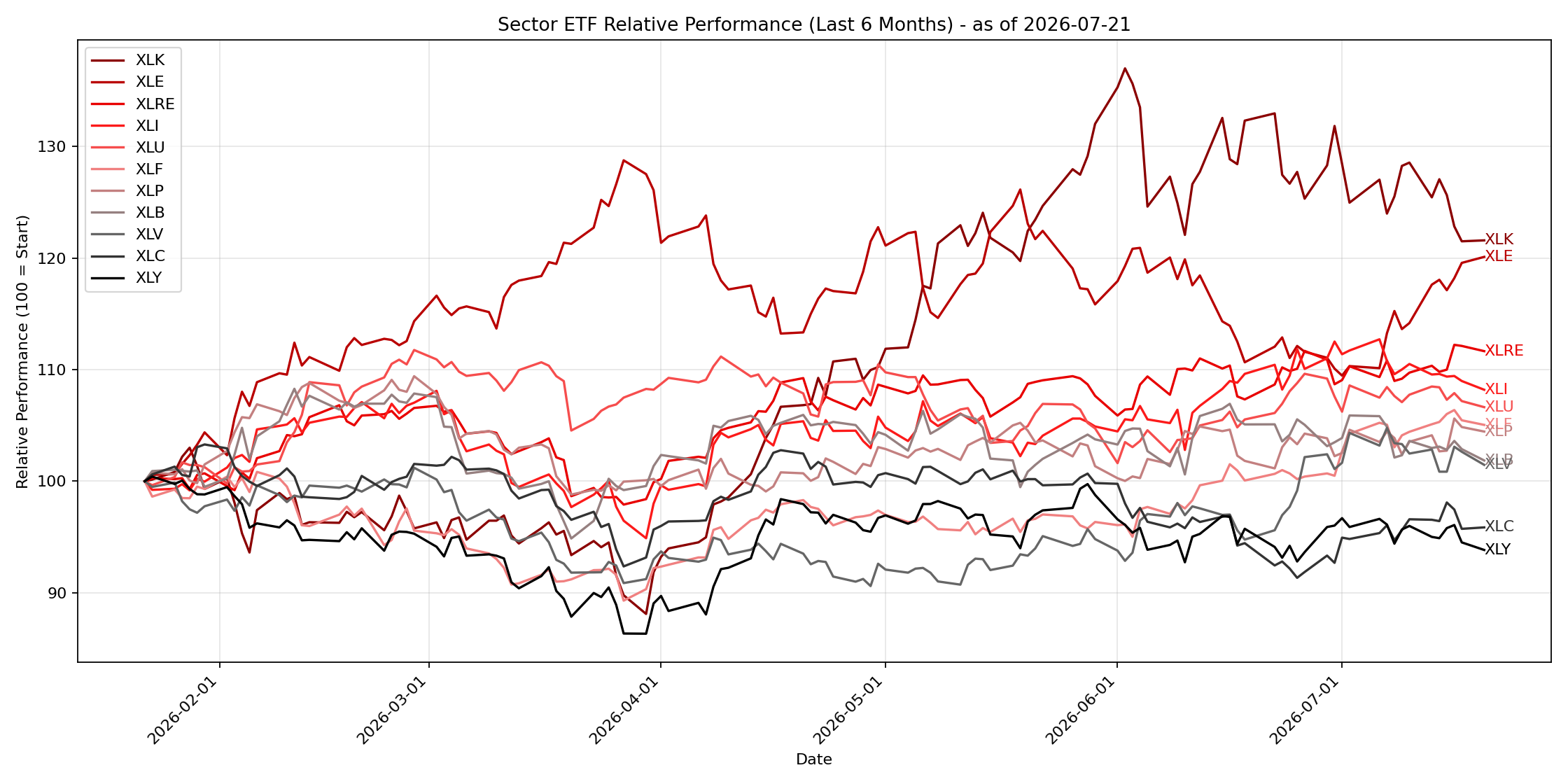
Technology
Theme
AI demand remains real, but investors are distinguishing cash-generative suppliers from infrastructure plans that depend on leverage, fresh financing and timely power access. Semiconductor capacity remains tight; the weakest AI infrastructure models are facing a hard test of funding and execution.
Movers
- TSM(Taiwan Semiconductor Manufacturing Company) reported a 68.7% year-over-year profit increase and a 66.4% gross margin, confirming strong demand for advanced chips. Its capacity allocation now has strategic consequences for customers including Broadcom, Apple and Nvidia.
- ASML(ASML) said demand for EUV tools exceeds its ability to supply through 2027 and potentially into 2028. A deep backlog and limited substitutes reinforce its position as a bottleneck supplier.
- AMD(Advanced Micro Devices) is pushing beyond chip sales with rack-scale systems and software partnerships aimed at improving GPU utilization. The strategy could make it a more credible alternative to Nvidia, though the stock’s sharp run-up raises the bar for execution.
- CRWV(CoreWeave) fell sharply as its unsecured bonds moved into distressed territory, while founders sold about $3.3 billion in shares after the IPO. The combination of heavy capital needs, weak free cash flow and insider selling has turned financing risk into a sector-wide concern.
- ORCL(Oracle) faces similar scrutiny: capital spending of $75.7 billion exceeded operating cash flow of $46.9 billion, despite a $638 billion future contract pipeline. The market is demanding evidence that AI backlog can convert into cash.
- ADBE(Adobe) was downgraded by HSBC amid concern that free, open-source AI tools could weaken its pricing power. Salesforce and Accenture offer a counterpoint: enterprise AI is gaining traction when embedded in existing workflows and backed by contracted demand.
Actionable Ideas (Positive)
- ASML(ASML) — Multi-year demand visibility and a hard-to-replicate EUV position support durable pricing power. The constrained supply base makes it a direct way to express continued advanced-chip investment.
- TSM(Taiwan Semiconductor Manufacturing Company) — Strong results and tight advanced-node capacity support the structural AI thesis. The key watchpoint is whether overseas expansion and customer concentration dilute margins.
Actionable Ideas (Negative)
- CRWV(CoreWeave) — Distressed bonds, large insider sales and heavy reliance on external financing weaken the equity case. Avoid until liquidity and cash generation improve.
- ADBE(Adobe) — The open-source threat puts the premium subscription model under pressure. A lower valuation is warranted until Adobe demonstrates that AI features can defend retention and pricing.
Financials
Theme
The financial backdrop is turning less forgiving: compliance failures are drawing immediate penalties, while rising credit stress and funding costs challenge the assumption that higher rates reliably support bank earnings. Payments firms are also competing to own stablecoin settlement infrastructure.
Movers
- BAC(Bank of America) agreed to a $1.2 billion Treasury settlement over AML and sanctions violations, prompting its steepest daily share decline since April 2025. The direct earnings hit is compounded by reputational and compliance-cost risk.
- JPM(JPMorgan Chase) flagged $65 billion in deeply distressed loans, up 62.5%, as Jamie Dimon warned of refinancing risks. The bank also reported its first fixed-income trading revenue decline in more than two years.
- CFG(Citizens Financial Group) delivered record revenue, 42% EPS growth and a 19-basis-point expansion in net interest margin to 3.19%. Cost savings and stable credit metrics make it a notable counterpoint to regional-bank concerns.
- AXP(American Express) faces a Federal Reserve enforcement action over AML deficiencies as operating expenses rise. The regulatory issue complicates an otherwise resilient affluent-spending story.
- MA(Mastercard) launched its Global Money Platform after acquiring BVNK, aiming to integrate stablecoin settlement into its cross-border network. The strategic opportunity is significant, but adoption and regulatory execution remain unproven.
Actionable Ideas (Positive)
- CFG(Citizens Financial Group) — Strong earnings, improving margins and progress on cost savings support a potential re-rating. The discount only closes if deposit costs and operating expenses remain controlled.
Actionable Ideas (Negative)
- BAC(Bank of America) — The $1.2 billion settlement is a concrete earnings and compliance setback, not just a sentiment issue. Underweight until remediation costs and further regulatory exposure become clearer.
Healthcare
Theme
Investors are rewarding execution and cash generation, while the GLP-1 market is shifting toward a more competitive, convenience-driven phase. Strong managed-care guidance and oncology data contrast with pressure on lagging operators and companies whose valuations depend on uncertain launches.
Movers
- UNH(UnitedHealth Group) beat earnings estimates and raised its 2026 adjusted EPS outlook to at least $20.50. The result makes cost control the sector’s clearest near-term differentiator.
- LLY(Eli Lilly) gained European regulatory momentum for Zepbound and oral candidate Foundayo, whose dosing convenience challenges Novo Nordisk’s oral Wegovy proposition.
- NVO(Novo Nordisk) is facing intensifying competition, U.S. pricing pressure and slower-than-expected oral Wegovy adoption. Its year-to-date share decline reflects a reset in growth expectations.
- ABBV(AbbVie) presented promising early oncology data at ESMO, including a 56% response rate for ABBV-706 in refractory small-cell lung cancer and breakthrough designations for Temab-A. These are meaningful pipeline signals, but still early-stage.
- JNJ(Johnson & Johnson) beat quarterly estimates and raised guidance, yet shares fell 2.25% as investors focused on patent cliffs and litigation risk.
- CVS(CVS Health) agreed to a $315 million opioid-related settlement. Its shares rose, but future litigation and regulatory exposure remain unresolved.
- HUM(Humana) fell 4.33% even as the healthcare sector rose, highlighting its relative weakness against UnitedHealth’s stronger cost performance.
Actionable Ideas (Positive)
- UNH(UnitedHealth Group) — The earnings beat and guidance increase validate operating discipline. Prefer the execution leader while managed-care peers remain under pressure.
- LLY(Eli Lilly) — European regulatory progress and a more convenient oral candidate strengthen its competitive position in a growing market. The key test is translating demand into supply and durable margins.
- ABBV(AbbVie) — The oncology data package improves the long-term growth case beyond its established franchises. Treat the clinical pipeline as upside optionality, not yet as near-term earnings.
Actionable Ideas (Negative)
- NVO(Novo Nordisk) — A less differentiated oral proposition and rising pricing pressure threaten the growth premium. Stay cautious until launch execution and market-share trends stabilize.
- HUM(Humana) — Underperformance during a strong sector tape signals a company-specific execution problem. Avoid until results show better cost control and competitive traction.
Industrials
Theme
The AI buildout is creating tangible demand for power equipment and infrastructure, while defense and aerospace remain supported by strategic backlogs. Investors are still demanding delivery: cost overruns, weak guidance and project delays can quickly undermine the long-cycle growth case.
Movers
- ETN(Eaton) is benefiting from tight transformer supply and rising demand for switchgear and electrical distribution. Grid constraints are supporting pricing power across the equipment chain.
- GD(General Dynamics) combines $6.6 billion in trailing free cash flow with a $136.5 billion backlog, offering unusually strong revenue visibility for a defense contractor.
- BA(Boeing) delivered 161 commercial aircraft in Q3, but its recovery still hinges on FAA certification of the 737 MAX 10 and control of supplier and quality issues.
- STLD(Steel Dynamics) faces a warning signal after issuing below-consensus guidance despite strong expected year-over-year growth. Forward visibility matters more than a backward-looking beat.
- CW(Curtiss-Wright) won a training-simulator contract for TerraPower’s Natrium project, strengthening its exposure to next-generation nuclear. The investment case remains sensitive to project timing and execution.
- WM(Waste Management) maintained guidance despite lower waste volumes, citing pricing and operating discipline; automation and its Stericycle acquisition add potential margin and service growth.
Actionable Ideas (Positive)
- ETN(Eaton) — Transformer scarcity and data-center power demand support sustained pricing and earnings leverage. Grid equipment is a direct, cash-generative way to invest in the AI infrastructure constraint.
- GD(General Dynamics) — A large backlog and strong free cash flow support earnings visibility amid geopolitical demand. Prefer the established cash-flow profile over more speculative defense technology exposure.
Actionable Ideas (Negative)
- STLD(Steel Dynamics) — Below-consensus guidance tempers the strong headline earnings setup and points to softer forward conditions. Avoid chasing the cycle until demand and tariff risks clear.
Transportation
Theme
Airlines have near-term pricing power, but a 91% rise in jet fuel since February threatens to absorb the benefit. Railroads show a more constructive volume backdrop, though fuel and operating costs remain a margin risk.
Movers
- DAL(Delta Air Lines) passed through a $10-per-way domestic fare increase and is better positioned than peers to serve affluent travelers. Its pricing discipline is the strongest airline offset to fuel inflation.
- AAL(American Airlines) and ALK(Alaska Air Group) face the same fuel shock, with upcoming results testing whether fare increases can protect margins without weakening demand.
- CP(Canadian Pacific Kansas City) is benefiting from improved operating efficiency and cross-border intermodal demand, while its valuation remains above one cash-flow-based estimate.
- CSX(CSX) completed the Howard Street Tunnel double-stack upgrade, expanding intermodal capacity and strengthening its ability to compete with trucking.
- UNP(Union Pacific) has posted four consecutive record quarters in volume and revenue, but rising fuel and operating costs put margin conversion in focus.
Actionable Ideas (Positive)
- CSX(CSX) — The Howard Street Tunnel upgrade adds durable intermodal capacity and creates a clearer path to capturing freight from trucks. Track volume conversion and operating leverage.
Consumer Discretionary
Theme
Consumer-facing businesses are separating into those that can extend their platforms and those confronting weaker demand, regulatory risk or strained brand relevance. Execution—not strategic ambition—is the dividing line.
Movers
- ABNB(Airbnb) added AI-powered search and on-trip services, aiming to capture more of the traveler’s spending beyond accommodation. The opportunity is higher booking conversion and broader wallet share; service quality is the execution risk.
- AMZN(Amazon) plans $220 billion in 2026 capital spending, with AWS growing 20% and above a $130 billion annualized run rate. At the same time, FTC scrutiny of pricing practices and rising infrastructure costs raise the stakes on returns.
- TSLA(Tesla) faces a regulatory probe into alleged robotaxi school-zone violations as EV sales weaken and management pursues ambitious AI and autonomy plans. The investment case remains unusually dependent on future execution.
- LVMUY(LVMH) is closing five Louis Vuitton stores in China amid weaker luxury demand and backlash over a trademark dispute. The pressure reflects both softer demand and a cultural-relevance problem.
- UBER(Uber) offered €41.50 per share for Delivery Hero, a move that could consolidate European delivery but brings substantial regulatory and integration risk.
Actionable Ideas (Positive)
- ABNB(Airbnb) — AI search and integrated trip services could lift conversion and ancillary revenue. The actionable signal is whether new features increase booking value without compromising the host-guest experience.
Actionable Ideas (Negative)
- LVMUY(LVMH) — Store closures and consumer backlash expose a structural challenge in China, not just a weak quarter. Stay underweight until demand and brand relevance stabilize.
Consumer Staples
Theme
Defensive cash generation is attracting investor attention, but pricing power is not universal. Tariffs, input costs and regulatory scrutiny are testing even established brands.
Movers
- COST(Costco) pairs 92.3% membership renewal with 6.6% comparable-sales growth, reinforcing the durability of its membership-led model.
- PG(Procter & Gamble) warned that core EPS could decline at least 5%, with $1 billion in tariff costs adding to input and shipping pressures. This challenges the sector’s defensive-growth assumption.
- UL(Unilever) faces Indian regulatory scrutiny over health claims on Horlicks, with potential implications for marketing and product claims in a major market.
- TSN(Tyson Foods) stood out in a defensive screen with an 11% trailing free-cash-flow yield, the highest among the names highlighted.
- Goldman Sachs also highlighted cash-generative staples including CL(Colgate-Palmolive), MDLZ(Mondelez International), SJM(J.M. Smucker) and KR(Kroger), reinforcing a broader rotation toward cash-flow visibility.
Actionable Ideas (Positive)
- COST(Costco) — High renewal rates and consistent comparable-sales growth support the premium valuation. The membership base remains a strong buffer against softer discretionary spending.
- TSN(Tyson Foods) — The 11% free-cash-flow yield offers a clear defensive value signal. The yield merits attention, with operating performance still the key confirmation.
Actionable Ideas (Negative)
- PG(Procter & Gamble) — Management’s EPS warning and tariff burden put margin resilience in question. Reduce exposure until the company shows it can absorb costs without sacrificing volume.
Communication Services
Theme
AI is expanding the strategic opportunity for platforms with scale, but spending alone is no longer enough to sustain valuations. Streaming and digital-media players face intensifying competition for attention and monetization.
Movers
- META(Meta Platforms) is investing $125–145 billion in 2026 AI infrastructure and promoting Muse as a new monetization opportunity. The market needs evidence that AI revenue can justify the capital burden.
- GOOGL(Alphabet) reported 82% Google Cloud growth at a 35.6% operating margin, while committing to a long-term power agreement for data-center capacity. Berkshire Hathaway’s reported $10 billion investment adds a notable endorsement.
- NFLX(Netflix) cut roughly 6% of its workforce and faces questions about content engagement, ad-tier growth and competition from YouTube. A leadership change in content signals a renewed push to regain cultural relevance.
- TME(Tencent Music Entertainment) stopped reporting quarterly user metrics as ByteDance’s Soda Music pressures its user base and premium subscriptions. Reduced transparency compounds competitive risk.
- CMCSA(Comcast) faces a key earnings test as investors assess cable, broadband and streaming performance; theatrical results were mixed.
Actionable Ideas (Positive)
- GOOGL(Alphabet) — Strong cloud growth and margin expansion show that AI investment is supported by an increasingly profitable business. Prefer demonstrated monetization over infrastructure plans alone.
Actionable Ideas (Negative)
- NFLX(Netflix) — Workforce reductions, content pressure and a falling share price point to a tougher growth phase. Require evidence of ad monetization and engagement recovery before adding exposure.
Energy
Theme
Geopolitical disruption is lifting supply risk and supporting oil and refining margins, while the energy transition is increasingly judged by delivered infrastructure and cash returns. High commodity prices help producers, but elevated expectations leave refiners exposed to a reversal in spreads.
Movers
- XOM(Exxon Mobil) attracted higher price targets from several banks, supported by strong Guyana and Permian production, refining margins and structural cost savings.
- SHEL(Shell) is using its 60-million-ton LNG position to generate cash flow across volatile gas markets, with low-carbon businesses adding diversification.
- BP(BP) expanded its India EV-charging strategy through partnerships while maintaining substantial upstream production. Utilization data will be needed to prove the transition economics.
- MPC(Marathon Petroleum), DINO(HF Sinclair) and PBF(PBF Energy) are benefiting from strong refining margins, but current valuations and regulatory or operational risks leave less room for error.
- Attacks on Russian oil infrastructure and uncertainty over sanctions are increasing the market’s sensitivity to supply interruptions.
Actionable Ideas (Positive)
- XOM(Exxon Mobil) — Production growth, cost savings and refining strength support earnings resilience. The case rests on operational execution rather than a simple oil-price bet.
- SHEL(Shell) — LNG scale and trading capabilities provide diversified cash generation in a volatile energy market. The combination of cash flow and a large global gas position is attractive.
Utilities
Theme
Data-center demand is creating a new growth case for power providers, but the value accrues to companies that can secure generation, grid access and regulatory approval. Capital intensity and elevated valuations make project execution decisive.
Movers
- AEP(American Electric Power) committed $4 billion to a 702-megawatt fuel-cell project backed by a 20-year Google power-purchase agreement. The deal validates demand for dedicated power, but the stock already reflects substantial AI optimism.
- DUK(Duke Energy) has 7.8 GW of secured data-center service agreements and plans 15 GW of generation expansion by 2031, favoring regulated, infrastructure-led growth.
- NEE(NextEra Energy) has a 35.1 GW renewables backlog, but rate sensitivity and project execution remain constraints.
- VST(Vistra) redeemed $1 billion of preferred stock, removing an 8% dividend burden and increasing flexibility for capital returns.
Actionable Ideas (Positive)
- VST(Vistra) — Preferred-stock redemption improves the capital structure and creates room for shareholder returns. **The next catalyst is
This content is for informational purposes only and does not constitute financial, investment, or trading advice. Always consult a qualified financial professional before making any investment decisions.
Daily Sector Pulse October 17, 2026
Technology
Theme
The market is separating cash-generative technology businesses from capital-intensive AI infrastructure bets. Strong demand for advanced chips persists, but inflation and financing concerns have made investors less willing to underwrite growth without visible returns.
Movers
- ANET(Arista Networks) stands out for 45.4% operating margins and cash generation that is less dependent on customer advances than peers. The quality of AI exposure is now a key differentiator.
- TSM(Taiwan Semiconductor Manufacturing Company) reported strong results and an upbeat outlook, with high-performance computing revenue up 22% quarter over quarter. Its execution contrasts with the selloff across much of the chip complex.
- CRWV(CoreWeave) plunged as credit markets questioned whether its debt-funded expansion can produce sustainable cash flow. The stress is weighing on AI infrastructure names well beyond the company itself.
- HPE(Hewlett Packard Enterprise), CIEN(Ciena), and COHR(Coherent) suffered steep declines as investors reassessed AI infrastructure growth and valuation. The correction is hitting suppliers even where long-term demand remains intact.
- CRM(Salesforce) reported 240% year-over-year growth in Agentforce ARR, while ADBE(Adobe) faced a downgrade over slowing organic growth and uncertainty about its competitive position as AI tools spread. Enterprise platforms with measurable monetization are gaining favor over software whose AI returns remain harder to prove.
Actionable Ideas (Positive)
- ANET(Arista Networks) — Its margin resilience and stronger underlying cash generation support a quality-over-beta position in AI networking.
- TSM(Taiwan Semiconductor Manufacturing Company) — Strong HPC demand and guidance provide fundamental support amid the sector’s valuation reset.
Actionable Ideas (Negative)
- CRWV(CoreWeave) — Heavy debt, negative cash flow, and refinancing dependence leave little room for a tightening in credit conditions.
- HPE(Hewlett Packard Enterprise) — The downgrade and sharp selloff reflect a missing, credible AI-led growth inflection; demand for infrastructure alone is not enough to defend its valuation.
Financials
Theme
Results were mixed: asset managers and select banks showed earnings power, while compliance failures and consumer-credit exposure remain material risks. Blockchain and AI are advancing as financial infrastructure, but neither removes the sector’s sensitivity to regulation, funding costs, and credit quality.
Movers
- GS(Goldman Sachs) beat estimates decisively, led by a 72% year-over-year increase in equities revenue and growth in asset and wealth management. The result highlights the value of diversified fee businesses.
- BLK(BlackRock) posted $206 billion in net inflows and reached $15.49 trillion in AUM. Strong core flows contrasted with outflows from its spot Bitcoin ETF, IBIT(iShares Bitcoin Trust).
- BAC(Bank of America) absorbed a $1.2 billion AML-related fine that pushed diluted EPS below expectations. The penalty raises questions about the cost and persistence of compliance weaknesses.
- JPM(JPMorgan Chase) missed EPS and revenue estimates despite strong net interest income, with weaker investment banking and capital markets results weighing on the quarter.
- HSBC(HSBC Holdings) moved its tokenized deposit service into a live cross-border use case with Ant International, a step toward institutional blockchain adoption beyond pilots.
- FMCC(Federal Home Loan Mortgage Corporation) and FNMA(Federal National Mortgage Association) fell sharply amid rising concern over housing affordability and mortgage-credit risk. The moves point to broader vulnerability in housing finance, not just company-specific news.
Actionable Ideas (Positive)
- GS(Goldman Sachs) — The earnings beat and strength in fee-generating businesses support a constructive view on its ability to perform through uneven capital-markets conditions.
- BLK(BlackRock) — Large net inflows and operating-margin strength reinforce the core asset-management thesis, notwithstanding near-term Bitcoin ETF outflows.
Actionable Ideas (Negative)
- BAC(Bank of America) — The size of the AML fine and risk of further scrutiny create a clear earnings and governance overhang.
- AGNC(AGNC Investment) — Its dividend is not supported by operating cash flow, leaving income investors exposed to rate-driven margin pressure and potential payout reduction.
Healthcare
Theme
Clinical and product progress continues to create upside, but legal liabilities, medical-cost inflation, and commercialization execution are setting the risk-adjusted outlook. Investors are rewarding evidence of durable earnings more than pipeline promise alone.
Movers
- UNH(UnitedHealth Group) raised full-year EPS guidance after adjusted EPS rose 61% year over year. Its decision to shed unprofitable memberships prioritizes margins over headline enrollment.
- ABBV(AbbVie) reported statistically significant Phase 3 progression-free survival results for epcoritamab plus R-CHOP in high-risk DLBCL, supporting its effort to broaden growth beyond legacy franchises.
- JNJ(Johnson & Johnson) beat adjusted EPS expectations and raised guidance, but a $5.5 billion talc litigation charge nearly erased GAAP profitability. Stelara competition and modest MedTech growth remain additional concerns.
- GH(Guardant Health) received encouraging real-world adherence data for its Shield screening test, but a patent ruling against its technology adds royalty obligations and pressure to an already cash-consuming business.
- GEHC(GE HealthCare) expanded its radiopharmaceutical capabilities with CE Mark approval for a cyclotron and support for Copper-64 production, advancing its push into theranostics.
Actionable Ideas (Positive)
- UNH(UnitedHealth Group) — The guidance increase and deliberate exit from unprofitable memberships support a margin-focused earnings thesis.
Actionable Ideas (Negative)
- GH(Guardant Health) — The upheld patent claims and willful-infringement finding add a structural cost burden while the company remains loss-making.
Industrials
Theme
Defense programs, data-center power, and jobsite automation are supporting long-term demand, but backlog only creates value if companies convert it into cash without margin erosion. Execution and production capacity remain the sector’s central tests.
Movers
- KTOS(Kratos Defense & Security Solutions) has a growing hypersonics opportunity supported by government funding and firm orders. The projected production ramp makes delivery and margin control increasingly important.
- NOC(Northrop Grumman) missed the hardware award in the Air Force’s Collaborative Combat Aircraft program but retained a software role. Its large backlog and strong free cash flow provide support, while a lower operating margin highlights program-cost risk.
- GD(General Dynamics) announced a CEO transition as it works through a $136.5 billion backlog. The leadership handoff comes as complex submarine programs and AUKUS milestones demand reliable execution.
- SWK(Stanley Black & Decker) received recognition for DEWALT’s DALE autonomous drilling robot, a sign that construction automation is moving beyond concept. Scaling adoption—not the accolade—will determine the commercial payoff.
- BKR(Baker Hughes) secured a long-term power framework agreement with Venture Global and GE Vernova for LNG and data-center applications, extending its revenue visibility into the next decade.
Actionable Ideas (Positive)
- KTOS(Kratos Defense & Security Solutions) — Firm program demand and a substantial projected hypersonics ramp support a growth thesis, with production execution the key milestone.
- SWK(Stanley Black & Decker) — DALE offers a differentiated route out of commoditized tools; monitor deployment and repeat orders as evidence of scalable demand.
Transportation
Theme
The sector is split between legal exposure and fuel-driven margin pressure on one side, and freight conversion and fleet modernization opportunities on the other.
Movers
- CHRW(C.H. Robinson) faces an affirmed $604 million verdict, plus accruing interest. If upheld on appeal, the ruling could expand broker liability across the freight industry.
- DAL(Delta Air Lines) cut full-year EPS guidance as fuel and other costs pressured margins, challenging the assumption that premium demand and loyalty can fully offset cost inflation.
- JBHT(J.B. Hunt Transport Services) recorded more than 578,000 intermodal loads in Q2, supporting the shift of freight from highway to rail and strengthening its contracted-volume story.
- INSW(International Seaways) agreed to buy four VLCCs for $370 million while committing to return at least 85% of adjusted earnings. The strategy increases exposure to freight rates and raises the bar for capital discipline.
Actionable Ideas (Positive)
- JBHT(J.B. Hunt Transport Services) — Record intermodal volume and network growth support a durable demand and operating-leverage thesis.
Actionable Ideas (Negative)
- CHRW(C.H. Robinson) — The size of the verdict and potential precedent create material downside that an appeal may not fully resolve.
- DAL(Delta Air Lines) — Lower guidance confirms that rising fuel and operating costs are eroding earnings despite a strong revenue base.
Consumer Discretionary
Theme
Brands are being tested on operational execution and the ability to defend customer loyalty against faster, lower-cost competitors. Strong sales or strategic announcements alone are not enough where valuation already assumes a clean turnaround.
Movers
- SBUX(Starbucks) reported 7.9% global comparable-sales growth and 430 basis points of operating-margin expansion, but the rapid rollout of drive-thru rival 7 Brew raises a longer-term competitive challenge.
- GME(GameStop) is extending its collectibles strategy through an eBay stake and PSA-related initiatives. The pivot has strategic logic, but sales and margin contribution remain unproven.
- EXPE(Expedia Group) is expanding One Key with loyalty benefits and price protection, seeking to convert bookings into repeat customer relationships.
- AMZN(Amazon) faces an FDA warning over unapproved drugs sold by third parties on its marketplace, exposing a compliance risk in a high-liability category as it continues to invest heavily in AI.
Consumer Staples
Theme
The main pressure is regulatory uncertainty around ultra-processed foods, which threatens the category’s pricing power and brand positioning. Coca-Cola’s foodservice win is a near-term commercial positive, but it does not remove the broader policy risk.
Movers
- KO(Coca-Cola) won KFC U.S.’s exclusive beverage business beginning in 2027, a meaningful distribution gain and a setback for PepsiCo.
- PEP(PepsiCo) lost the KFC account after decades of partnership, while facing the same potential labeling and consumer-perception risks affecting packaged food and beverage peers.
- KHC(Kraft Heinz) and HSY(Hershey) are particularly exposed to proposed scrutiny of processed packaged foods and confectionery. Any eventual rules could pressure demand, marketing, and compliance costs.
- COST(Costco Wholesale) remains a defensive retailer with a resilient membership model; a senior executive’s sizeable share sale is notable but does not by itself alter the operating thesis.
Actionable Ideas (Negative)
- PEP(PepsiCo) — The KFC loss is a tangible distribution setback layered on top of a regulatory overhang for core product categories.
Communication Services
Theme
AI investment is creating a split between media businesses with visible audience monetization and platforms committing enormous capital before returns are clear. Regulatory and political scrutiny adds another layer of risk for the largest platforms.
Movers
- FOXA(Fox Corporation) is benefiting from Tubi’s reported 35% revenue growth and 110 million monthly users, alongside election-related advertising demand. The test is whether streaming growth can translate into durable margins beyond the political cycle.
- META(Meta Platforms) is pushing open AI models and consumer agents, but large infrastructure outlays are expected to weigh on free cash flow. JPMorgan CEO Jamie Dimon’s public warning about payment-enabled AI agents also raises trust and regulatory questions.
- GOOGL(Alphabet) faces the same tension: substantial AI investment supports its competitive position but is expected to pressure near-term free cash flow. A reported $22 million political donation from a legal settlement also creates reputational risk.
- NFLX(Netflix) replaced its content chief and cut 6% of its workforce as it targets higher margins and seeks to refresh engagement. The strategy will be tested against signs of content fatigue.
Actionable Ideas (Positive)
- FOXA(Fox Corporation) — Tubi’s audience and revenue growth provide a tangible streaming catalyst, with margin delivery the key confirmation.
Energy
Theme
Geopolitical supply risk is driving oil higher, while natural gas is moving in the opposite direction. Producers with strong operating leverage benefit from the oil rally, but the risk premium could unwind quickly if disruptions ease.
Movers
- EOG(EOG Resources), CVX(Chevron), and APA(APA Corporation) gained as Middle East tensions and attacks on Russian refineries lifted crude and refined-product prices.
- BKR(Baker Hughes) is benefiting from a longer-term shift toward LNG and data-center power through its agreement with Venture Global and GE Vernova.
- EPD(Enterprise Products Partners) raised its distribution and completed a $1.82 billion unit repurchase program while funding a large growth-project pipeline. Delivery and cash-flow coverage will determine whether shareholder returns remain sustainable.
- UNG(United States Natural Gas Fund) fell as natural-gas futures declined despite anticipated colder weather, underscoring that the crude rally is not lifting all energy exposures.
Actionable Ideas (Positive)
- EOG(EOG Resources) — Supply disruption risk and strong U.S. inventory draws support near-term earnings leverage, while recognizing that this thesis is sensitive to geopolitical de-escalation.
Actionable Ideas (Negative)
- UNG(United States Natural Gas Fund) — The futures decline despite a near-term weather catalyst signals weak momentum and a supply backdrop that is outweighing seasonal demand expectations.
Utilities
Theme
Utilities are becoming direct partners in the AI buildout, with hyperscaler-funded infrastructure offering a way to add capacity without shifting costs to existing customers. The opportunity is attractive, but regulatory approvals and premium valuations leave little tolerance for execution delays.
Movers
- NI(NiSource) signed a 20-year agreement under which Microsoft will fund 1,100 MW of generation and transmission infrastructure. The structure supports data-center growth while limiting ratepayer and balance-sheet pressure.
- D(Dominion Energy) remains tied to a proposed merger with NEE(NextEra Energy). Approval could support the growth narrative; delays or rejection would expose the premium valuation and execution risks.
Actionable Ideas (Positive)
- NI(NiSource) — The Microsoft-funded project provides long-duration demand visibility while reducing the usual financing burden on the utility and its customers.
Real Estate
Theme
Real estate performance is diverging: hotel and logistics demand remain resilient, while office and life-science assets face weaker fundamentals and data-center growth is running into financing and dilution concerns.
Movers
- ARE(Alexandria Real Estate Equities) fell after BMO cut its rating to Sell and reduced its 2027 core FFO estimate by 26%, citing weaker office and life-sciences demand.
- PLD(Prologis) beat FFO expectations and raised core guidance, but its large equity issuance and lower net-earnings outlook have raised concerns about dilution and the cost of expansion.
- EQIX(Equinix) declined despite its data-center position, as investors questioned whether AI-related capital spending can earn adequate returns in a higher-cost funding environment.
- HST(Host Hotels & Resorts) rose as broker Buy initiations supported confidence in the lodging sector’s post-recovery growth profile.
Actionable Ideas (Negative)
- ARE(Alexandria Real Estate Equities) — The sharp downward revision to expected FFO and persistent tenant-demand concerns point to continued pressure on valuation.
- PLD(Prologis) — Repeated equity issuance and reduced net-earnings guidance weaken the per-share growth case despite solid operating results.
Materials
Theme
The materials news flow is split between operational improvement at selected producers and acute margin stress from input costs. Policy support and structural demand are positive, but valuation and commodity-cycle risks remain material.
Movers
- AA(Alcoa) reported higher revenue, production, and adjusted income, supported by the Alumar restart and stronger output. A $672 million one-time gain flatters reported earnings, while energy and bauxite costs remain important constraints.
- CMC(Commercial Metals) reported stronger margins and $250 million in run-rate cost savings, with lower capex raising the prospect of improved free-cash-flow conversion.
- MOS(The Mosaic Company) recorded a $273 million quarterly net loss as higher sulfur costs squeezed fertilizer margins, putting its dividend and valuation under pressure.
- AEM(Agnico Eagle Mines) generated $1.3 billion in Q2 free cash flow, highlighting the advantage of low-cost gold assets as input costs rise.
Actionable Ideas (Positive)
- AA(Alcoa) — Improved output and cash generation support a constructive view, with ELYSIS commercialization a longer-term potential catalyst.
- CMC(Commercial Metals) — Cost savings and declining capex provide a credible path to stronger cash conversion and a possible valuation re-rating.
Actionable Ideas (Negative)
- MOS(The Mosaic Company) — Losses driven by input-cost inflation undermine the case for both its earnings multiple and dividend sustainability.
Crypto
Theme
Institutional crypto
This content is for informational purposes only and does not constitute financial, investment, or trading advice. Always consult a qualified financial professional before making any investment decisions.
Daily Sector Pulse October 16, 2026
Technology
Theme
The AI trade is shifting from growth-at-any-cost to proof of returns and financing discipline. Strong demand remains visible in advanced chips and server backlogs, but higher rates, leverage and uncertain cash conversion are exposing the weakest infrastructure and software models.
Movers
- TSM(Taiwan Semiconductor Manufacturing Company) reported record results, strong margins and capacity sold out through 2026. Demand is real, but constrained fabrication capacity is becoming a bottleneck for the wider AI supply chain.
- MU(Micron Technology) delivered explosive earnings growth on AI-memory demand, yet its shares fell with the semiconductor selloff. The divergence shows investors are discounting financing and cycle risks even when current results are strong.
- DELL(Dell Technologies) reported a $95 billion AI-server backlog, but warned that shortages in memory and GPUs could delay deliveries and squeeze its thin margins.
- CRWV(CoreWeave) fell sharply as debt, funding needs and insider selling intensified scrutiny of leveraged AI infrastructure. The market is demanding cash-flow evidence, not just contracted growth.
- HUBS(HubSpot) and TWLO(Twilio) illustrate the software pricing challenge: cheaper AI agents threaten per-seat and per-interaction economics, while weak guidance and valuation concerns have amplified the pressure.
Actionable Ideas (Positive)
- TSM(Taiwan Semiconductor Manufacturing Company) — Record execution and sold-out advanced-node capacity support durable pricing power. Favor the supply-chain bottleneck over speculative compute capacity.
- ADI(Analog Devices) — Its relative resilience in the selloff reflects steadier industrial, automotive and aerospace demand. Use analog exposure to diversify away from capital-intensive AI bets.
Actionable Ideas (Negative)
- CRWV(CoreWeave) — Heavy funding needs, rising credit concerns and substantial insider sales leave little margin for execution slippage. Avoid leveraged AI infrastructure until cash generation catches up with expansion.
- TWLO(Twilio) — A high multiple, falling momentum and risk of disintermediation make the stock vulnerable if AI adoption weakens its pricing model. Do not pay for AI optionality without clearer monetization.
Financials
Theme
Results are separating firms with pricing power and operating discipline from those facing regulatory, capital or earnings-quality problems. Strong activity and fee income are not enough to offset weak controls, rising costs or deteriorating balance-sheet signals.
Movers
- PGR(Progressive) posted an improved combined ratio and earnings beat, showing that disciplined underwriting can still deliver margin strength despite catastrophe and pricing pressures.
- CFG(Citizens Financial Group) expanded net interest margin and beat EPS estimates, but tangible book value and capital measures weakened, tempering the benefit of its buyback and dividend plans.
- BAC(Bank of America) absorbed a $1.21 billion AML and sanctions penalty. The required controls overhaul makes this more than a one-quarter expense.
- BX(Blackstone) entered earnings with falling performance revenues, downward estimate revisions and weaker sentiment than peers, pointing to a loss of momentum in alternative asset management.
- V(Visa) gained approval to establish a wholly owned domestic card-clearing business in China, a meaningful expansion opportunity, while USDC settlement initiatives extend its payments infrastructure into stablecoins.
Actionable Ideas (Positive)
- PGR(Progressive) — A sub-90 combined ratio alongside premium growth supports the case for sustained underwriting advantage. Favor demonstrated risk selection over broad insurance-sector exposure.
- V(Visa) — China approval and stablecoin settlement capabilities strengthen its long-term network opportunity. Treat the China opening as a strategic growth option, not near-term earnings certainty.
Actionable Ideas (Negative)
- BAC(Bank of America) — The compliance penalty and mandated systems overhaul raise ongoing operating costs and control risk. Stay cautious until the bank demonstrates sustained remediation.
- BX(Blackstone) — Weakening performance revenues and negative estimate revisions challenge the earnings outlook. Avoid assuming a quick recovery without evidence of fee and realization improvement.
Healthcare
Theme
Commercial execution is rewarding companies with differentiated products, while payer pressure and legacy-product competition are exposing weak earnings foundations. Across the sector, growth quality matters more than headline revenue or defensive labels.
Movers
- ABBV(AbbVie) continues to replace Humira with rapid growth from Skyrizi and Rinvoq, validating its portfolio transition.
- IONS(Ionis Pharmaceuticals) received a positive European regulatory recommendation for expanded use of TRYNGOLZA. Trial results showed large triglyceride reductions and fewer pancreatitis events, opening a meaningful new market if final approval follows.
- ALC(Alcon) won FDA approval for Brytly, an OTC eye drop with a differentiated duration and safety profile that directly challenges Bausch + Lomb’s Lumify.
- MOH(Molina Healthcare) faces falling Marketplace membership and a 93% medical care ratio, while ELV(Elevance Health) is losing Medicare Advantage and Medicaid membership. Membership erosion and medical-cost pressure are impairing managed-care earnings visibility.
- UNH(UnitedHealth Group) raised guidance and improved its medical care ratio, showing that portfolio discipline and cost control can still offset membership declines.
Actionable Ideas (Positive)
- IONS(Ionis Pharmaceuticals) — The positive CHMP opinion and strong clinical outcomes provide a defined regulatory and commercial catalyst. Track final EU approval and launch execution as the next proof points.
- ABBV(AbbVie) — Skyrizi and Rinvoq are producing current, high-growth revenue that is offsetting Humira erosion. Prefer demonstrated replacement growth over pipeline-only recovery stories.
Actionable Ideas (Negative)
- MOH(Molina Healthcare) — The sharp membership decline, elevated care ratio and reduced outlook point to worsening operating leverage. Avoid until membership stabilizes and medical-cost trends improve.
- BLCO(Bausch + Lomb) — Weak returns and cash generation meet a direct product threat from Alcon’s Brytly. The combination of operational weakness and intensifying competition makes the downside thesis unusually concrete.
Industrials
Theme
Infrastructure and defense demand are supporting backlogs, but investors are rewarding delivery and margins—not just exposure to long-cycle spending. AI-related demand is broadening into power, construction and industrial services, while weaker project execution remains a clear liability.
Movers
- CAT(Caterpillar) reported a $72 billion backlog and strong power-generation demand, linking its equipment franchise to data centers and grid investment as well as conventional construction.
- EME(EMCOR Group) moved its U.S. Industrial Services segment back into operating profit on strong revenue growth. That is evidence of a meaningful execution and margin inflection, not just sector demand.
- GE(GE Aerospace) benefits from a $210 billion backlog and strong engine demand, but its premium valuation raises the bar for earnings delivery.
- AVAV(AeroVironment) added major defense contracts and backlog, but forecast negative free cash flow through FY2027 keeps conversion of awards into cash under scrutiny.
- ACM(AECOM) reported a steep revenue decline, missed estimates and weak EBITDA guidance, prompting a sharp post-results selloff.
Actionable Ideas (Positive)
- EME(EMCOR Group) — The return to profitability in U.S. Industrial Services, combined with rising estimates, supports a constructive view. Favor operators converting infrastructure demand into measurable margin improvement.
- CAT(Caterpillar) — Backlog depth and power-generation growth provide broader exposure to infrastructure spending than a narrow AI trade. Use diversified industrial demand as a higher-quality way to play the buildout.
Actionable Ideas (Negative)
- ACM(AECOM) — Revenue deterioration and guidance weakness point to more than a temporary earnings miss. Avoid until organic growth and margin execution show evidence of a reset.
Transportation
Theme
Strong revenue and freight activity are not translating consistently into profit. Fuel, labor and other operating costs are pressuring carriers, making margins and cost recovery the sector’s key tests.
Movers
- AAL(American Airlines) paired record revenue with a steep operating-income decline and a guided quarterly loss, underscoring severe cost pressure.
- DAL(Delta Air Lines) beat revenue expectations but missed EPS and lowered its near-term outlook. Investors are prioritizing profit conversion over demand growth.
- JBHT(J.B. Hunt Transport Services) grew revenue 20%, but unexpected costs compressed operating margins and contributed to an EPS miss.
- CSX(CSX) is expected to report strong intermodal demand and substantial margin expansion, making its results a useful read-through on rail efficiency and supply-chain activity.
Actionable Ideas (Negative)
- AAL(American Airlines) — Rising fuel and non-fuel costs, a guided loss and deteriorating earnings revisions leave a weak near-term setup. Underweight until management demonstrates cost control and a credible path back to profitability.
Consumer Discretionary
Theme
Demand is uneven, and margin resilience is separating the winners from businesses relying on volume or promotional activity. Cruise bookings and Pro-oriented home improvement remain firm, while apparel and restaurant signals point to greater consumer caution.
Movers
- RCL(Royal Caribbean Cruises) reported strong bookings and pricing, but its premium valuation leaves little room for execution setbacks.
- CCL(Carnival Corporation) beat on revenue and EPS, yet weaker EBITDA guidance raises questions about how much demand is converting into profit.
- NKE(Nike) rallied after results, but revenue declined and demand remained soft in Greater China and key franchises. The rebound still depends on inventory and margin execution.
- HD(Home Depot) is benefiting from Pro demand and larger tickets, but operating margins are at a decade low, limiting the quality of its growth.
- CMG(Chipotle Mexican Grill) remains exposed to high expectations after recent weakness, with investors focused on whether sales growth can support its valuation.
Actionable Ideas (Negative)
- CCL(Carnival Corporation) — Below-consensus EBITDA guidance challenges the sustainability of its post-earnings rally. Require margin recovery before adding exposure.
Consumer Staples
Theme
Scale and distribution remain powerful advantages, but the battle for customer access is shifting toward digital services and high-value partnerships.
Movers
- WMT(Walmart) grew global e-commerce 23% and is expanding automated fulfillment and fee-based services, reinforcing its shift beyond low-price retail.
- KO(Coca-Cola) won Yum Brands’ U.S. beverage business beginning in January, while PEP(PepsiCo) loses an important quick-service restaurant relationship. The change is strategically significant for distribution and brand reach, though its direct earnings impact should be assessed in context.
Communication Services
Theme
Distribution is being challenged on both fronts: satellite spectrum threatens incumbent wireless economics, while media companies are seeking tighter control of streaming platforms and content.
Movers
- VZ(Verizon) and TMUS(T-Mobile US) face a potential new competitor after SpaceX acquired nationwide low-band spectrum. The threat is structural, but commercial scale and execution remain unproven.
- FOX(Fox Corporation) plans to acquire ROKU(Roku), a deal that could combine content with a large streaming distribution platform. Regulatory approval and integration will determine whether the proposed synergies materialize.
Actionable Ideas (Negative)
- VZ(Verizon) — The spectrum development puts pressure on the long-term assumption that incumbent networks retain an uncontested advantage in rural coverage. Reassess the durability of pricing power and capital returns as Starlink’s service develops.
Energy
Theme
Geopolitical disruption and tight fuel inventories are transferring value toward refiners, while energy infrastructure is gaining strategic importance as data-center power demand grows. These tailwinds are substantial, but refining profits remain exposed to a rapid reversal in supply conditions.
Movers
- MPC(Marathon Petroleum) and VLO(Valero Energy) are benefiting from exceptional refining margins amid a global diesel shortage. The supply squeeze is supporting near-term earnings, but also raises the risk of peak-cycle expectations.
- XOM(Exxon Mobil) reported strong refining economics and a major cash-flow contribution from Guyana, though lower oil prices and timing effects weighed on quarterly profit.
- KMI(Kinder Morgan) is positioned to benefit from natural-gas demand tied to LNG, power generation and data centers through its fee-based pipeline network.
- HAL(Halliburton) stands out negatively: weak gross margins and rising capital intensity suggest it is not capturing the broader energy strength effectively.
Actionable Ideas (Positive)
- XOM(Exxon Mobil) — Guyana production and a strong balance sheet provide durable cash generation beyond the current refining cycle. Prefer integrated quality over a pure bet on peak refining margins.
Actionable Ideas (Negative)
- HAL(Halliburton) — Persistent margin weakness despite favorable energy conditions signals poor operating leverage. Avoid until profitability improves rather than relying on a low headline multiple.
Utilities
Theme
Data-center power demand is becoming a material growth driver for utilities, but the value accrues only where contracts and regulatory recovery support the required investment.
Movers
- NI(NiSource) signed a 20-year agreement with Microsoft for a data-center campus, with Microsoft funding new generation and storage. The structure links load growth to dedicated investment rather than shifting costs to existing customers.
- VST(Vistra) has long-term nuclear power agreements with major technology customers, while a conditional DOE loan commitment could reduce the capital risk of extending plant life.
- PCG(PG&E) faces forecast earnings decline despite revenue growth, reflecting continued pressure from costs and regulation.
Actionable Ideas (Positive)
- NI(NiSource) — The long-term, customer-funded power agreement offers unusually clear visibility into incremental demand and infrastructure funding. Favor contracted load growth over uncommitted data-center forecasts.
Actionable Ideas (Negative)
- PCG(PG&E) — Earnings are forecast to fall despite growing
This content is for informational purposes only and does not constitute financial, investment, or trading advice. Always consult a qualified financial professional before making any investment decisions.
Daily Sector Pulse October 15, 2026
Technology
Theme
The market is separating AI infrastructure with visible demand and cash generation from debt-dependent capacity bets. Hotter inflation and higher financing costs pressured semiconductors broadly, but long lead times, strong orders and durable backlogs point to real demand beneath the volatility.
Movers
- NVDA(NVIDIA) remains the ecosystem anchor, with reported data-center revenue up 117% year over year and partnerships spanning chip design and networking. Its influence is increasingly systemic: it supports the bull case for infrastructure while concentrating market risk in one stock.
- TSM(TSMC) reported 41.1% revenue growth and 66.4% gross margin, with demand outpacing supply. Shares nevertheless sold off with the sector, exposing the gap between strong company fundamentals and macro-driven positioning.
- ADI(Analog Devices) and NXPI(NXP Semiconductors) saw reports of lead times stretching to 26 weeks or longer in some products. That points to tight supply and pricing power beyond AI GPUs, including industrial and data-center analog chips.
- MU(Micron Technology) and SNDK(Sandisk) are benefiting from tight memory supply and AI storage demand, but both were caught in the semiconductor selloff. Sandisk’s contracted revenue visibility contrasts with investors’ growing sensitivity to rates and sector concentration.
- CRWV(CoreWeave) became a credit-market warning signal: its bonds yielded about 15%, while credit-default swaps implied severe default risk. ORCL(Oracle) also faces scrutiny as large AI capex collides with permitting delays, weak free cash flow and rising credit spreads.
Actionable Ideas (Positive)
- ADI(Analog Devices) — Extended lead times and stronger industrial and data-center demand support a high-conviction relative long in analog semiconductors, where pricing power is improving outside the GPU complex.
- KLAC(KLA) — A $12.6 billion backlog and strong advanced-packaging demand provide unusually clear revenue visibility. Favor process-control exposure over less differentiated, debt-funded AI capacity.
Actionable Ideas (Negative)
- CRWV(CoreWeave) — Distressed bond yields and default-risk pricing make the funding model the immediate issue, not backlog growth. Avoid or underweight until the company demonstrates credible deleveraging and cash-flow conversion.
Communication Services
Theme
AI is intensifying the contest for attention, distribution and customer access. At the same time, satellite-to-phone ambitions are creating a longer-term competitive threat for terrestrial wireless operators.
Movers
- META(Meta Platforms) is embedding AI across its consumer platforms and expanding infrastructure partnerships. The opportunity is substantial, but returns depend on monetization keeping pace with capital spending.
- GOOGL(Alphabet) benefits from YouTube’s growing share of TV viewing and continued cloud and AI investment. Its software partnerships also extend Android into connected vehicles, though investors still want clearer evidence that AI investment will translate into durable incremental revenue.
- TMUS(T-Mobile US) faces a strategic challenge from SpaceX’s satellite-to-phone plans, including its spectrum acquisition. The threat is most relevant in rural and underserved areas, where terrestrial coverage is weakest.
Financials
Theme
A strong capital-markets backdrop is being offset by compliance failures, catastrophe losses and pressure on earnings quality. Investors are rewarding firms with recurring flows and execution, but punishing governance and underwriting risk.
Movers
- GS(Goldman Sachs) delivered a strong quarter, with revenue up 23% year over year and equities revenue up 72%. The results reinforce the earnings leverage in capital markets, though management warned that financing costs could constrain AI investment.
- BLK(BlackRock) recorded $205 billion in client inflows and expanded its role in AI infrastructure financing. Its tokenized-fund initiative also advances institutional blockchain adoption.
- BAC(Bank of America) faces a $1.2 billion regulatory penalty tied to AML and sanctions-control failures, alongside findings that it overstated compliance progress. This is a governance and credibility problem, not just a one-off charge.
- ALL(Allstate) reported $1.65 billion in third-quarter catastrophe losses, keeping weather volatility in focus for property insurers.
- JPM(JPMorgan Chase) missed earnings and revenue expectations as fixed-income trading weakened and expenses rose. Its capital position remains strong, but cost control and revenue mix are under pressure.
Actionable Ideas (Positive)
- GS(Goldman Sachs) — Record equities activity and stronger investment-banking fees support a selective long on capital-markets momentum, with financing costs the key risk to watch.
Actionable Ideas (Negative)
- BAC(Bank of America) — The penalty and compliance findings threaten trust, invite further scrutiny and could add legal and operating costs. Underweight until remediation is demonstrated.
- ALL(Allstate) — Repeated catastrophe losses are challenging earnings predictability and underwriting assumptions. Favor insurers with more resilient catastrophe exposure.
Healthcare
Theme
Large, diversified healthcare firms are demonstrating resilience, while payer cost pressure and restructuring expose weak spots. Clinical data and guidance raises are supporting select growth stories, but execution and reimbursement remain decisive.
Movers
- ABBV(AbbVie) reported Phase 3 lymphoma results showing a 51% reduction in the risk of progression or death for an epcoritamab combination. The data strengthens its effort to build oncology into a third growth pillar.
- AMGN(Amgen) beat Q2 expectations, raised full-year guidance and advanced Tarlatamab in a high-need cancer setting. The results reinforce a pipeline story backed by current earnings growth.
- UNH(UnitedHealth Group) raised FY26 adjusted EPS guidance to at least $20.50 as its medical care ratio improved to 88.4%. The update signals better cost control and a credible operational recovery.
- CVS(CVS Health) disclosed $2.3 billion in charges, including costs tied to Medicare and individual-market pressures and store closures. The scale of the charges raises questions about the durability of its retail and benefits economics.
- ELV(Elevance Health) faces falling membership and a 23.9% decline in Health Benefits operating income, with a high benefit expense ratio weighing on profitability.
Actionable Ideas (Positive)
- UNH(UnitedHealth Group) — The guidance raise and lower medical care ratio provide tangible evidence that cost control is improving. Favor the recovery trade while monitoring membership and Medicare Advantage execution.
- AMGN(Amgen) — A raised outlook alongside positive oncology pipeline progress supports a quality-biotech long with less reliance on speculative future revenue.
Actionable Ideas (Negative)
- CVS(CVS Health) — Large restructuring and market-related charges point to deeper pressure across the business. Avoid treating the stock as a defensive healthcare holding until the earnings base stabilizes.
- ELV(Elevance Health) — Membership erosion and declining segment income threaten both revenue growth and margins. Underweight pending evidence of improved cost and enrollment trends.
Industrials
Theme
AI investment is creating direct demand for power, cooling and industrial equipment, while investors increasingly expect that demand to convert into profitable orders. Defense and nuclear activity add a second source of durable project visibility.
Movers
- CAT(Caterpillar) reported 72% year-over-year growth in power-generation sales tied to AI projects, with orders extending into 2030. The company is monetizing data-center power needs through its existing industrial franchise.
- BWXT(BWX Technologies) raised FY26 EPS and free-cash-flow guidance after commercial-operations sales rose 72% year over year. That marks a meaningful expansion beyond its traditional defense exposure.
- ETN(Eaton) is investing in capacity and grid infrastructure as data-center and electrification demand expands. Its premium valuation leaves execution and order conversion central.
- EME(EMCOR Group) reported strong organic growth and remains exposed to the mechanical and electrical work required for data-center construction.
Actionable Ideas (Positive)
- BWXT(BWX Technologies) — Higher commercial sales and raised guidance provide direct evidence of demand conversion. Buy on the nuclear growth and cash-flow inflection, not just the sector narrative.
- CAT(Caterpillar) — Strong AI-related power-generation growth and long-dated orders support a selective long in industrial power equipment.
Transportation
Theme
Revenue and demand resilience are not consistently translating into margins. Labor, fuel and cost pressures remain the key near-term tests across airlines, trucking and rail.
Movers
- UAL(United Airlines) is expanding Starlink coverage and signed an engine-exchange agreement to reduce maintenance downtime. However, consensus EPS estimates fell 44.3% in a month, sharply weakening the profit outlook despite strong revenue.
- ALK(Alaska Air Group) faces escalating pilot-contract tensions at Horizon Air. A prolonged dispute could raise labor costs and disrupt the regional operating model.
- JBHT(J.B. Hunt Transport Services) grew revenue 20% year over year, but operating income rose only 2% as margins compressed. Dedicated Contract Services operating income fell 22% despite revenue growth.
- UNP(Union Pacific) remains tied to regulatory approval of its Norfolk Southern merger. The promised synergies are material, but so is the downside if regulators block or materially delay the deal.
Actionable Ideas (Negative)
- JBHT(J.B. Hunt Transport Services) — Margin compression despite strong revenue, plus a diesel-cost shock and very low cash, weakens the quality of the beat. Underweight until operating leverage recovers.
- UAL(United Airlines) — The steep downward revision in EPS estimates outweighs the operational improvements for now. Avoid ahead of results unless profit expectations stabilize.
Consumer Discretionary
Theme
Consumers remain selective, and the market is demanding proof of profitable growth rather than sales momentum alone. Housing-related retailers face weak traffic, while brand and labor risks are adding pressure elsewhere.
Movers
- **
This content is for informational purposes only and does not constitute financial, investment, or trading advice. Always consult a qualified financial professional before making any investment decisions.
Daily Sector Pulse October 14, 2026
Technology
Theme
AI infrastructure demand remains strong, but the market is separating durable orders from debt-funded capacity bets. Higher rates and ASML’s warning that EUV supply will fall short in 2027–28 expose both financing risk and a physical bottleneck in the buildout.
Movers
- ASML(ASML) raised its 2026 revenue outlook but said it cannot meet chipmakers’ demand in 2027–28, even with planned capacity growth. That constraint threatens to slow the broader AI supply chain.
- AVGO(Broadcom) is extending its AI position beyond accelerators into high-speed networking, with Tomahawk 6 and projected AI semiconductor revenue of $58 billion in FY2026. Demand reportedly exceeds capacity.
- AMZN(Amazon) reported 37% AWS revenue growth and 39.4% margins, while a $54.2 billion quarterly capex outlay pushed trailing free cash flow negative. The market’s next test is returns on AI spending.
- CRWV(CoreWeave) fell sharply as its unsecured bonds yielded 14.5%–15%; debt and lease obligations have ballooned to $52 billion. The selloff is raising questions about the financing model for AI compute.
- PLTR(Palantir) reported 149% year-over-year revenue growth and $6.24 billion in remaining deal value, demonstrating that enterprise AI is moving into production. Its valuation remains exceptionally demanding.
Actionable Ideas (Positive)
- AVGO(Broadcom) — AI demand is translating into strong growth across chips and networking. Favor exposure to the infrastructure layer with demonstrated customer demand and an expanding product footprint.
Actionable Ideas (Negative)
- CRWV(CoreWeave) — Bond yields near distressed levels, rising leverage and negative cash flow leave little room for slower demand or higher funding costs. Avoid the equity; the debt repricing puts the business model under immediate scrutiny.
Financials
Theme
Regulatory risk moved from a compliance issue to a sector-wide confidence test after authorities cited major banks for alleged debanking and imposed a multibillion-dollar AML and sanctions penalty on Bank of America. Against that backdrop, BlackRock and Goldman Sachs showed that strong flows and capital-markets activity can still drive results.
Movers
- BAC(Bank of America) was hit with a $1.96 billion regulatory penalty tied to AML and sanctions-control failures; shares fell as much as 8.6% in a session. The prior cease-and-desist order increases the governance overhang.
- JPM(JPMorgan Chase), PNC(PNC Financial), USB(U.S. Bancorp) and WFC(Wells Fargo) were among banks named in an OCC report on alleged debanking practices. The allegations raise the prospect of added scrutiny, compliance costs and reputational damage across the industry.
- BLK(BlackRock) beat earnings expectations with $205 billion in net inflows and record AUM of $15.49 trillion. Private-market inflows and Aladdin growth point to strength beyond passive funds.
- GS(Goldman Sachs) delivered a strong Q3, with EPS of $17.01 and revenue up 23% year over year, supported by financing and deal activity.
Actionable Ideas (Positive)
- BLK(BlackRock) — Record inflows, scale and growth in private markets support earnings resilience. Favor the diversified asset manager over firms more dependent on volatile trading or transaction revenue.
Actionable Ideas (Negative)
- BAC(Bank of America) — The penalty followed repeated compliance failures, not a one-off control lapse. Underweight until management demonstrates credible remediation and regulators reduce the overhang.
Healthcare
Theme
Pipeline innovation and operating recovery are meeting tougher tests on pricing, regulation and execution. New approvals and clinical progress support select franchises, while reimbursement pressure and uneven demand keep broad sector conviction in check.
Movers
- NVS(Novartis) won FDA approval for Rhapsido in two chronic-hives indications. The drug’s potential in multiple sclerosis could extend the opportunity, but the valuation case now depends partly on follow-on clinical results.
- REGN(Regeneron Pharmaceuticals) is advancing next-generation Dupixent candidates designed to extend the franchise beyond its expected patent window. Upcoming data could shape the longer-term growth outlook.
- UNH(UnitedHealth Group) raised its 2026 earnings outlook after margins improved and Optum Health earnings rebounded. Falling ACA enrollment remains a material headwind to the recovery.
- ISRG(Intuitive Surgical) posted strong revenue and procedure growth, but lack of da Vinci 5 clearance in China and softer U.S. procedure growth temper the outlook.
Actionable Ideas (Positive)
- NVS(Novartis) — The Rhapsido approval adds a commercial asset in immunology, with additional upside contingent on MS data. The regulatory win improves pipeline breadth and provides a concrete catalyst.
Industrials
Theme
Electrification, data-center power and defense demand are supporting order visibility, but valuations and execution requirements are rising. Companies with real backlog and operating leverage stand apart from those still relying on turnaround promises.
Movers
- ETN(Eaton) is benefiting from durable demand in power management and data-center infrastructure; Citi sees scope for stronger organic growth and operating leverage.
- LMT(Lockheed Martin) secured a $6.3 billion, five-year Standard Missile-3 contract and is investing to expand missile production. The award adds visibility amid sustained defense demand.
- CAT(Caterpillar) is benefiting from data-center power demand and a record backlog, though regulatory scrutiny of agricultural equipment adds risk to its premium valuation.
- BA(Boeing) faces continued pressure from negative earnings revisions and a large quarterly loss forecast, keeping its turnaround thesis fragile.
Actionable Ideas (Positive)
- ETN(Eaton) — Strong demand across electrification and data-center infrastructure supports durable growth. Favor the power-management exposure over more speculative AI infrastructure plays.
Actionable Ideas (Negative)
- BA(Boeing) — Weak execution and downward estimate revisions continue to undermine the recovery case. Avoid adding exposure until results show sustained operational improvement.
Transportation
Theme
Cost inflation and labor friction are eroding the benefits of strong passenger and freight demand. Airlines face the sharpest margin pressure, while select logistics operators retain pricing and execution advantages.
Movers
- DAL(Delta Air Lines) cut its 2026 earnings outlook as fuel costs surged; lower free cash flow and falling estimates point to sustained margin pressure.
- AAL(American Airlines) is expected to report a loss, with estimates deteriorating rapidly ahead of earnings. Its outlook appears weaker than peers’.
- ALK(Alaska Air Group) faces escalating Horizon Air pilot unrest, including public picketing and a no-confidence vote against an operations executive. A prolonged dispute could disrupt schedules and increase labor costs.
- ODFL(Old Dominion Freight Line) enters earnings with positive estimate revisions and a record of consistent beats, contrasting with cost and service concerns at some transport peers.
Actionable Ideas (Positive)
- ODFL(Old Dominion Freight Line) — Consistent execution and pricing power distinguish it from a pressured transport group. Prefer the LTL operator over airlines exposed to fuel-cost shocks.
Actionable Ideas (Negative)
- DAL(Delta Air Lines) — Guidance cuts, higher fuel costs and a sharp decline in free cash flow weaken the earnings outlook. Underweight until fuel costs stabilize and margin guidance bottoms.
Consumer Discretionary
Theme
Performance is bifurcating between retailers converting digital engagement into sales and brands losing share or pricing credibility. Inflation and higher yields add pressure to discretionary demand.
Movers
- TGT(Target) reported 8.7% digital comparable-sales growth, with same-day delivery up more than 25%; AI partnerships are driving faster growth in external-platform traffic. The recovery still depends on execution in core categories.
- AEO(American Eagle Outfitters) posted 7.5% revenue growth and a fourth consecutive quarter of men’s business growth, showing resilience in youth apparel.
- NKE(Nike) is losing share to competitors including Lululemon and Adidas as sports equipment outgrows sportswear. Its premium valuation leaves limited room for execution missteps.
- MCD(McDonald’s) faces weak U.S. comps after inconsistent execution of its value strategy, including low franchisee adoption of key pricing offers.
Actionable Ideas (Positive)
- TGT(Target) — Digital growth and AI-driven customer acquisition provide measurable traction. Favor the retailer where online engagement is already translating into sales growth.
Actionable Ideas (Negative)
- NKE(Nike) — Share losses and category shifts challenge the growth model, while valuation remains demanding. Avoid until product momentum and regional share trends improve.
Consumer Staples
Theme
Pricing power is separating resilient brands from packaged-food companies struggling to offset weak volumes and input-cost inflation. Cost savings alone are not enough when demand continues to soften.
Movers
- MDLZ(Mondelez International) grew organic revenue and expanded adjusted gross margin, outperforming peers on pricing and productivity.
- CPB(The Campbell’s Company) forecast a 2%–4% decline in fiscal 2027 organic sales after margin contraction, underscoring weak category demand.
- KHC(Kraft Heinz) expects lower organic sales and earnings, despite new product launches and a maintained dividend.
- KO(Coca-Cola) continued to deliver strong margins and growth, but its premium valuation raises the bar for future results.
Actionable Ideas (Positive)
- MDLZ(Mondelez International) — Revenue growth and margin expansion amid input-cost pressure demonstrate stronger pricing and execution. Prefer the operator converting productivity into both sales and profit growth.
Actionable Ideas (Negative)
- CPB(The Campbell’s Company) — Falling sales guidance and margin compression show that savings are not offsetting weak demand. Avoid until volumes stabilize and gross margins recover.
Communication Services
Theme
AI is intensifying competition for user attention, while satellite connectivity threatens the economics of traditional telecom networks. Companies with large platforms have an opportunity to extend their reach, but monetization and infrastructure returns remain unproven.
Movers
- META(Meta Platforms) is scaling its Muse AI agent and integrating commerce features with Shopify, Shop Pay and PayPal. The push could deepen engagement and challenge Apple’s AI ecosystem position.
- TMUS(T-Mobile US) faces a strategic threat from SpaceX’s acquisition of 800 MHz spectrum, which could support a broader satellite-terrestrial mobile offering.
- NFLX(Netflix) is cutting 1,000 jobs, including in product and technology, as it seeks cost discipline amid streaming competition. The cuts risk weakening capabilities central to product differentiation.
Energy
Theme
Geopolitical disruption and tight fuel inventories are boosting refining economics, even as inflation and supply risk complicate the outlook. Midstream and LNG assets retain long-term demand support, while individual companies remain exposed to execution and commodity volatility.
Movers
- VLO(Valero Energy) is benefiting from strong refining margins and upward earnings revisions, with low-cost feedstock access supporting profitability.
- PSX(Phillips 66) is gaining from tight global refining capacity and elevated crack spreads, although its valuation already reflects optimism.
- BP(BP) has seen a sharp rise in refining margins and is reducing debt, but faces $3–$4.5 billion of expected transition-asset impairments.
- BKR(Baker Hughes) reported record orders, led by industrial and energy technology demand, while its Chart Industries integration remains a key execution test.
Actionable Ideas (Positive)
- VLO(Valero Energy) — Strong refining margins and upward earnings revisions provide direct support to near-term earnings. Use the refiner for exposure to current fuel-supply tightness, while monitoring the cycle.
Utilities
Theme
Data-center demand is creating a new growth case for power providers, but the required capital is testing balance sheets and regulatory frameworks. The opportunity is strongest where projects have committed customers and credible cost recovery.
Movers
- AEP(American Electric Power) plans a $4 billion fuel-cell project backed by a 20-year Google power agreement, but high leverage and prior equity issuance raise financing and execution risks.
- NGG(National Grid) committed $1.75 billion for a 35% stake in a U.S. data-center power infrastructure venture, a significant move beyond traditional utility growth.
- CEG(Constellation Energy) has signed long-term power deals with major technology companies, but elevated outage days and capital intensity put reliability under scrutiny.
- EIX(Edison International) faces a sharp increase in wildfire-liability concerns following a report alleging more than $20 billion in potential exposure.
Actionable Ideas (Negative)
- EIX(Edison International) — The alleged wildfire exposure threatens cost recovery and could constrain the capital plan. Avoid until liability and regulatory outcomes become clearer.
Materials
Theme
Copper supply risk is strengthening the strategic value of miners as electrification and AI infrastructure lift demand. Labor disruption at a major mine is an immediate catalyst, while aluminum and lithium stories remain more dependent on deal execution and price recovery.
Movers
- BHP(BHP Group) faces a strike at Escondida, the world’s largest copper mine. The dispute has pushed copper higher and could tighten an already constrained market.
- FCX(Freeport-McMoRan) is positioned to benefit from record copper prices and strong earnings expectations, with a track record of significant earnings surprises.
- AA(Alcoa) is restarting smelters and pursuing a downstream acquisition expected to create substantial synergies, though the transaction is still pending.
- ALB(Albemarle) is drawing interest as battery-storage demand adds to lithium growth, but the stock remains sensitive to a still-uncertain price recovery.
Actionable Ideas (Positive)
- FCX(Freeport-McMoRan) — Tight supply and high copper prices support earnings momentum. Favor the producer with direct exposure to the copper price cycle and near-term estimate support.
Real Estate
Theme
Asset quality and talent retention are becoming clearer differentiators as financing conditions remain tight. High-quality office developments can still attract capital, but brokerage defections threaten the service businesses that depend on relationships.
Movers
- BXP(BXP) sold a minority stake in its 343 Madison Avenue development while retaining control; the project is 56% pre-leased. The deal brings in capital without surrendering operating control.
- CBRE(CBRE Group) lost several senior Chicago brokers to rivals, including a downtown tenant-representation team. The departures put client relationships and local market share at risk.
Actionable Ideas (Negative)
- CBRE(CBRE Group) — Concentrated broker losses across key Chicago segments create a tangible threat to retention and market share. Underweight until the firm demonstrates a credible response and stabilizes its team.
Crypto
Theme
Crypto is gaining relevance as financial infrastructure, but high valuations and episodic institutional outflows keep the sector exposed to sharp sentiment swings. Adoption of settlement and agentic-commerce tools is advancing faster than confidence in crypto-linked balance-sheet strategies.
Movers
- COIN(Coinbase) is expanding Base and the x402 payments protocol, with adoption by major technology and payments firms supporting a broader infrastructure thesis. Its valuation still assumes substantial growth beyond trading.
- BMNR(Bitmine Immersion Technologies) may be nearing the end of its Ethereum accumulation streak, forcing investors to reassess a thesis built around continued token purchases.
- ETH(Ethereum) saw large holders selling into the market even as another whale accumulated, highlighting a split in near-term positioning.
This content is for informational purposes only and does not constitute financial, investment, or trading advice. Always consult a qualified financial professional before making any investment decisions.
Daily Sector Pulse October 13, 2026
Technology
Theme
AI infrastructure demand remains strong, but the market is separating contracted orders from expensive promises. Optics, networking and server suppliers are gaining visibility; at the same time, rising financing costs and China’s advancing memory capabilities are testing the durability of AI-related pricing power.
Movers
- AAOI(Applied Optoelectronics) reported 800G revenue up more than tenfold year over year and secured over $200 million in 1.6T orders. Demand exceeds near-term capacity, reinforcing the case for sustained pricing power—provided the production ramp stays on schedule.
- LITE(Lumentum) said AI-related optical components are sold out through early 2029, while revenue and earnings accelerated sharply. That is unusually strong demand visibility, though its premium valuation leaves little room for delivery setbacks.
- MRVL(Marvell Technology) reported data-center revenue growth of 46% and set ambitious fiscal 2028 revenue targets. Hyperscaler relationships and 1.6T connectivity products support the outlook, but execution must match a demanding valuation.
- DELL(Dell Technologies) cited a $95 billion AI-server backlog and doubled AI-server sales year over year. The backlog validates demand, but GPU and component availability remain the conversion risk.
- WDAY(Workday) launched its Trusted Agent Platform, emphasizing governed access, audit trails and support for multiple AI models. Enterprise governance is emerging as a practical prerequisite for deploying autonomous agents in HR and finance.
- MU(Micron Technology) faced renewed pressure from Taiwan labor tensions and the prospect of faster Chinese memory development. Those risks challenge the scarcity-driven pricing assumptions behind the memory trade.
Actionable Ideas (Positive)
- AAOI(Applied Optoelectronics) — Orders and supply constraints provide the clearest near-term evidence of demand translating into revenue and pricing leverage. Favor exposure to the optical buildout, while monitoring capacity execution.
Actionable Ideas (Negative)
- ADBE(Adobe) — HSBC downgraded the stock after an open-source, AI-generated Creative Cloud alternative emerged. The threat is not just user churn; it is potential erosion of Adobe’s premium pricing power. Avoid until Adobe demonstrates that AI strengthens, rather than commoditizes, its product moat.
Financials
Theme
Results diverged sharply: trading-oriented firms benefited from active markets, while compliance failures and underwriting pressure exposed weaker economics. Banks are also moving AI into controlled internal workflows rather than opening customer accounts to external agents.
Movers
- BAC(Bank of America) received a $1.21 billion penalty over systemic anti-money-laundering and sanctions failures, including more than $5 billion in unreported suspicious transactions. The fine is material, but prolonged regulatory oversight and reputational damage are the larger risks.
- GS(Goldman Sachs) posted a 31.9% EPS beat, led by a 72% rise in equities trading revenue and higher investment-banking fees. The result confirmed strong capital-markets activity, though that tailwind is cyclical.
- C(Citigroup) beat Q3 estimates and raised its medium-term return target, but higher credit provisions and a lower CET1 ratio tempered the reaction. A projected $9 billion CTA-related loss in 2027 remains a significant overhang.
- AIG(American International Group), HIG(The Hartford) and CB(Chubb) all faced scrutiny over book-value or underwriting metrics. Revenue growth alone did not reassure investors when capital generation and profitability disappointed.
- MA(Mastercard) expanded tools for digital wallets and AI-driven commerce, while V(Visa) received approval to establish a domestic card-clearing business in China. Both moves extend payment networks into new transaction flows, but local competition and execution will determine the payoff.
Actionable Ideas (Positive)
- GS(Goldman Sachs) — The large earnings beat and strong equities and banking revenues support near-term earnings momentum. Favor the capital-markets recovery, while recognizing its sensitivity to trading conditions.
Actionable Ideas (Negative)
- BAC(Bank of America) — The penalty reflects a systemic control failure, not a routine compliance expense. Underweight given the combination of direct earnings cost, mandated oversight and credibility risk.
Healthcare
Theme
Clinical and commercial news favored companies converting innovation into measurable outcomes, while debt, legal exposure and weak pipelines remained unforgiving. The strongest signals came from late-stage data and regulatory progress, not broad AI or precision-medicine claims.
Movers
- BEAM(Beam Therapeutics) reported first-in-human proof of concept for in-vivo base editing in a genetic disease. A single infusion improved fasting tolerance and sharply reduced starch intake; durability and safety remain the decisive tests for the platform.
- BMY(Bristol Myers Squibb) reported Phase III success for RYZ101, an alpha-emitting therapy for neuroendocrine tumors—the first such therapy to succeed in a Phase III trial. Mixed results for another late-stage candidate, admilparant, underscore the unevenness of the pipeline.
- ABBV(AbbVie) reported strong Phase III data for subcutaneous SKYRIZI in Crohn’s disease, with regulatory submissions underway. The results strengthen its post-Humira growth case in immunology.
- UNH(UnitedHealth Group) beat earnings expectations and raised full-year guidance, helped by a lower-than-expected medical care ratio. The improved outlook supports its recovery narrative, though membership losses and Medicare policy risk remain.
- JNJ(Johnson & Johnson) saw pharma growth offset by weaker MedTech performance and renewed talc-litigation exposure, including a $4.1 billion jury verdict. The verdict’s durability on appeal will matter more than a single quarter’s product strength.
Actionable Ideas (Positive)
- ABBV(AbbVie) — Strong Crohn’s data and submissions underway support further growth from SKYRIZI. The clinical catalyst reinforces an already established commercial franchise.
Actionable Ideas (Negative)
- BIIB(Biogen) — A failed late-stage Alzheimer’s trial, steep earnings deterioration and stagnant revenue leave the low multiple looking like a reflection of business risk, not a bargain. Avoid absent a credible pipeline reset.
Industrials
Theme
Defense and power infrastructure continued to attract orders, while cyclical equipment and construction names faced weaker demand and high execution hurdles. Backlog quality and conversion—not headline growth alone—remain the key differentiators.
Movers
- GD(General Dynamics) is positioned to benefit from accelerating naval procurement and schedule-incentivized shipbuilding contracts. A growing backlog paired with productivity gains offers a clearer path to margin expansion than a simple defense-spending theme.
- LHX(L3Harris Technologies) secured a $6 billion-plus THAAD propulsion contract and expanded counter-drone production. These wins reinforce long-term demand, but the production ramp must keep pace with the awards.
- HWM(Howmet Aerospace) raised its 2026 free-cash-flow outlook to as much as $1.95 billion, supported by strong aerospace demand and pricing power. Its near-50% airfoil share strengthens the margin story.
- DE(Deere) faces a projected 15%–20% decline in equipment demand as high rates and farm input costs weigh on customers. The premium valuation is increasingly difficult to defend without a recovery in orders.
- BA(Boeing) increased deliveries, but its core aircraft businesses remained loss-making. The recovery is operationally visible but not yet profitable, leaving the stock vulnerable to another major program charge.
Actionable Ideas (Positive)
- GD(General Dynamics) — Naval modernization and contract structures that reward schedule performance support backlog conversion and potential margin improvement. Favor this exposure over less visible defense growth stories.
Actionable Ideas (Negative)
- DE(Deere) — Weak farm economics are translating into a material equipment-demand decline. Avoid treating the stock as a recovery play until order trends confirm a turn.
Transportation
Theme
Rail volumes and freight execution looked more resilient than airline economics. For carriers, cost control and service differentiation matter more when fuel, labor and capital costs pressure margins.
Movers
- CNR(Canadian National Railway) reported rail ton-miles up 4% across key commodities and maintained strong operating efficiency, despite diesel-cost pressure. Its relative valuation discount makes the operational resilience notable.
- DAL(Delta Air Lines) will not begin Starlink installations until 2028, behind peers already rolling out high-speed connectivity. The delay risks surrendering a visible customer-service advantage during a period of intense airline competition.
- INSW(International Seaways) reported strong earnings momentum, added four LR1 product carriers and maintained substantial shareholder returns. The tanker trade has been rewarded, but charter rates and deployment remain cyclical.
Actionable Ideas (Positive)
- CNR(Canadian National Railway) — Resilient volumes, strong efficiency and a valuation discount support a constructive view if diesel costs stabilize.
Actionable Ideas (Negative)
- DAL(Delta Air Lines) — A two-year lag in Starlink deployment creates a tangible service disadvantage against faster-moving rivals. Underweight until the rollout gap narrows or Delta presents a credible alternative.
Consumer Discretionary
Theme
Consumer preference is shifting faster than established brands can respond. Youth mindshare favored newer footwear names, while weak discretionary growth and premium valuations left legacy brands exposed.
Movers
- NKE(Nike) was downgraded by Bank of America, which cited a 26% currency-neutral revenue decline in Greater China, weaker North American wholesale trends and a projected high-single-digit revenue decline in FY27. Teen survey results also showed lost relevance.
- ONON(On Running) gained teen mindshare, particularly among boys, as Nike’s appeal weakened. The survey is an early signal of potential share movement, not yet proof of sustained sales conversion.
- CMG(Chipotle Mexican Grill) reported high-single-digit comparable-sales growth in Europe under its direct-ownership model, supporting the case that its international expansion can travel beyond the U.S.
- BYDDY(BYD) faces a new EU cap on Chinese hybrid imports alongside a 28.1% year-over-year fall in China sales. The combination threatens both domestic demand and export growth.
Actionable Ideas (Positive)
- CMG(Chipotle Mexican Grill) — European comparable-sales growth validates the direct-ownership expansion model. Favor the company’s demonstrated execution over acquisition speculation.
Actionable Ideas (Negative)
- NKE(Nike) — Weakness across China, wholesale and teen relevance points to a structural turnaround rather than a short cyclical pause. Avoid until product and distribution momentum recover.
Consumer Staples
Theme
Results separated brands with genuine volume or category momentum from those relying on price increases to mask weakening demand. North American execution remains the central pressure point for large packaged-food companies.
Movers
- PEP(PepsiCo) cut the expected performance bonus tied to its Poppi acquisition from $117 million to $12 million and lowered its 2026 EPS outlook to 1%–2%. The shortfall highlights weak U.S. execution, not merely a single underperforming product.
- KO(Coca-Cola) continued to outperform financially, but teen survey results showed weaker relevance than Dr Pepper and energy drinks. The brand’s current pricing power is strong; long-term youth engagement is the watchpoint.
- SJM(The J.M. Smucker Company) reported 12% sales growth in Uncrustables and accelerated capacity expansion to meet demand. The brand has meaningful room to grow from its current household penetration.
- HRL(Hormel Foods) expanded adjusted operating margins, but retail volumes remained soft. Foodservice profitability is helping offset, not eliminate, the top-line concern.
Actionable Ideas (Positive)
- SJM(The J.M. Smucker Company) — Uncrustables growth and capacity investment support continued volume expansion, with a valuation below the industry average.
Actionable Ideas (Negative)
- PEP(PepsiCo) — Weak North American volumes, margin pressure and the Poppi shortfall point to broad execution challenges. Stay underweight until the U.S. business stabilizes.
Communication Services
Theme
AI is raising the bar for engagement and monetization, while satellite connectivity is becoming a credible competitive threat to terrestrial telecom. Strong investment narratives still need evidence of durable returns.
Movers
- META(Meta Platforms) gained momentum around its Muse AI products, but projected 2026 capex of $125–145 billion and weaker free cash flow raise the cost of proving that AI can sustain earnings growth.
- GOOGL(Alphabet) reported rapid Google Cloud growth and a large contracted backlog, but heavy AI spending drove negative quarterly free cash flow. The strategic opportunity is substantial; the test is whether investment converts into cash generation.
- T(AT&T), TMUS(T-Mobile US) and VZ(Verizon Communications) faced a more direct threat as SpaceX expanded its spectrum position and signaled plans for mobile service. The potential launch remains uncertain, but it is already challenging assumptions about carrier pricing power.
- NFLX(Netflix) faces questions over engagement transparency and teen relevance even as it pursues live sports. Its operating margins remain strong, but growth now depends on content and product execution.
Actionable Ideas (Negative)
- T(AT&T) — SpaceX’s potential mobile entry increases long-term competitive risk just as AT&T is relying on domestic network investment to drive growth. Avoid treating the low multiple as sufficient protection against a changing connectivity market.
Energy
Theme
Geopolitical disruption is supporting conventional energy cash flows, while tariffs and project execution are challenging parts of the transition trade. The best-positioned operators are those with strong balance sheets, integrated assets or contracted infrastructure.
Movers
- XOM(Exxon Mobil) generated $14.7 billion in adjusted Q2 earnings and $17.2 billion in free cash flow as oil prices rose. The results validate its operating leverage, but earnings remain exposed to a reversal in the geopolitical price premium.
- BP(BP) accelerated debt reduction ahead of schedule, but announced $3–4.5 billion of impairments in gas and low-carbon assets. The balance-sheet reset is constructive; the write-downs show that transition investment has not consistently earned its cost of capital.
- EPD(Enterprise Products Partners) benefits from fee-based contracts and data-center-driven gas demand, with a large pipeline of growth projects supporting distributions.
- FLNC(Fluence Energy) cut near-term revenue guidance by $700 million and suspended contract execution after a 155% U.S. tariff on Chinese battery imports. The policy shock directly impairs its ability to deliver projects and protect margins.
Actionable Ideas (Positive)
- EPD(Enterprise Products Partners) — Fee-based cash flows
This content is for informational purposes only and does not constitute financial, investment, or trading advice. Always consult a qualified financial professional before making any investment decisions.
Daily Sector Pulse October 12, 2026
Technology
Theme
AI infrastructure spending is migrating beyond accelerators into optics, memory, networking, power management, and storage. Demand is real, but funding intensity and execution now separate suppliers with visible orders from companies relying on distant scale-up plans.
Movers
- LITE(Lumentum) says key optical components are sold out through 2029, with substantial unmet demand into 2028. The supply constraint strengthens its pricing position and confirms that optical interconnects are a bottleneck in AI deployment.
- AAOI(Applied Optoelectronics) reported more than $200 million in 1.6T orders and is expanding capacity. The orders validate demand, though delivery and ramp execution remain the test.
- MU(Micron Technology) is benefiting from tight high-bandwidth memory supply and customer agreements that provide revenue visibility. The scale of expected growth has made it a major contributor to semiconductor earnings, while competition and valuation leave little room for execution slippage.
- SMCI(Super Micro Computer) faces a potentially severe compliance crisis after reports of $2.5 billion in illegal AI-server exports to China. Regulatory exposure and loss of customer trust now outweigh the near-term hardware growth story.
- CRWV(CoreWeave) and APLD(Applied Digital) illustrate the sector’s financing divide: large AI backlogs coexist with heavy debt, cash burn, and significant delivery requirements.
- MSFT(Microsoft) is pushing further into custom AI silicon with Maia 300, a long-term challenge to external chip dependence. Broadcom’s growing role in AI infrastructure financing also extends its exposure beyond chip supply into credit risk.
Actionable Ideas (Positive)
- LITE(Lumentum): Confirmed shortages and multi-year demand visibility support a bullish view on optical supply-chain leverage. Favor the scarce component provider while monitoring its ability to expand output.
- AAOI(Applied Optoelectronics): Secured 1.6T orders and rising production capacity provide tangible demand validation. The actionable angle is order conversion and execution, not the discount to prior highs.
Actionable Ideas (Negative)
- SMCI(Super Micro Computer): The reported export violations create acute legal, regulatory, and customer-retention risks. Avoid exposure until the compliance and leadership consequences are clear.
- APLD(Applied Digital): Rapid revenue growth is accompanied by widening losses, high debt, and substantial capital needs. The funding and liquidity risk outweighs contracted-demand headlines.
Communication Services
Theme
SpaceX’s spectrum acquisition has forced investors to reprice the threat of satellite-enabled mobile service to incumbent carriers. The competitive risk is credible, but a scaled network still depends on regulatory approval, capital, and execution.
Movers
- SpaceX’s purchase of nationwide low-band spectrum triggered sharp declines in TMUS(T-Mobile US), VZ(Verizon), and T(AT&T). The move raises the prospect of new competition in underserved markets and challenges the assumption that terrestrial networks alone protect carrier economics.
- META(Meta Platforms) is extending its AI push across consumer and enterprise products. Early retention for its Muse model is encouraging, but the scale of infrastructure spending makes monetization a key earnings test.
- CMCSA(Comcast) faces potential congressional scrutiny over pricing, privacy, and broadband affordability, adding political and reputational risk.
Actionable Ideas (Negative)
- TMUS(T-Mobile US), VZ(Verizon), and T(AT&T): The spectrum move raises the risk of future pressure on subscriber growth and pricing power. Treat the group as exposed to a new competitive overhang; the threat is long-dated, not yet a proven operating loss.
Financials
Theme
Financials face a split between durable fee and brokerage franchises and businesses exposed to weaker deal activity, credit uncertainty, or balance-sheet pressure. Earnings guidance and capital quality matter more than the usual assumption that higher rates automatically lift bank profitability.
Movers
- BAC(Bank of America), C(Citigroup), GS(Goldman Sachs), JPM(JPMorgan Chase), and WFC(Wells Fargo) are entering earnings season amid weak investment-banking pipelines and investor concern about fintech competition. Results and forward guidance will test whether resilient deposits and trading can offset softer deal activity.
- AJG(Arthur J. Gallagher) is forecast to outgrow BRO(Brown & Brown), with stronger organic growth and cash conversion. BRO faces weaker commissions, acquisition-related leverage, and margin pressure.
- AIG(American International Group), HIG(Hartford), and CB(Chubb) drew scrutiny after book-value misses despite revenue growth. The divergence highlights the market’s focus on insurer capital quality, not just premium expansion.
- FIS(Fidelity National Information Services) is showing early AI-product adoption alongside a strong free-cash-flow recovery, while its debt burden remains a constraint.
- FMCC(Freddie Mac) and FNMA(Fannie Mae) face renewed common-equity dilution concerns and a weaker privatization outlook.
Actionable Ideas (Positive)
- AJG(Arthur J. Gallagher): Stronger growth and cash generation support a relative long against BRO(Brown & Brown). Prefer the broker with better organic momentum and integration discipline.
Actionable Ideas (Negative)
- FMCC(Freddie Mac) and FNMA(Fannie Mae): Treasury dilution risk and fading privatization expectations threaten common shareholders. Avoid the common equity until there is credible progress on capital structure and policy.
Healthcare
Theme
Medicare Advantage quality ratings are creating a sharp divide in managed care, while pharmaceutical growth is increasingly determined by pipeline evidence and competitive positioning. Quality-linked reimbursement has become a material earnings driver, not a secondary operating metric.
Movers
- HUM(Humana) is expected to place 95% of Medicare Advantage members in plans rated four stars or better, potentially supporting substantial 2028 bonus payments. The ratings contrast sharply with pressure at peers.
- CVS(CVS Health) and ELV(Elevance Health) face material Star Rating deterioration and projected profit impacts. The declines point to operational and retention problems in government-backed plans.
- LLY(Eli Lilly) is broadening its growth base through obesity drugs and an approved IBD product, while NVO(Novo Nordisk) faces failed or disappointing trials, pricing pressure, and stronger competition.
- BMY(Bristol Myers Squibb) reported positive late-stage results in pulmonary fibrosis and radiopharmaceutical treatment, adding potentially valuable pipeline assets.
Actionable Ideas (Positive)
- HUM(Humana): The improved ratings create a credible path to higher bonus revenue and strengthen its relative position in Medicare Advantage. Favor Humana over plans facing rating deterioration, while tracking medical-cost trends.
Actionable Ideas (Negative)
- CVS(CVS Health) and ELV(Elevance Health): Lower Star Ratings threaten government bonus revenue and expose execution gaps. Underweight until management demonstrates rating recovery and improved member retention.
- NVO(Novo Nordisk): Trial setbacks, falling realized prices, and tougher competition weaken the near-term growth case. Avoid relying on long-range pipeline targets until the company restores credible near-term milestones.
Industrials
Theme
AI data-center construction is lifting demand for power equipment, electrical systems, and mission-critical infrastructure. Aerospace and defense remain supported by strong demand, but cash conversion and valuation are differentiating winners from high-backlog, low-cash-flow stories.
Movers
- CAT(Caterpillar), CMI(Cummins), and GNRC(Generac) are expanding exposure to data-center power. Caterpillar’s Power & Energy growth and Cummins’ storage and generator wins show that the build-out extends beyond technology hardware; Generac’s large Amazon agreement comes with lower-margin product mix.
- PWR(Quanta Services) has a record backlog and strong demand across grid and data-center projects. Its high growth expectations also raise the cost of any execution miss.
- MTZ(MasTec) reported strong revenue and backlog but negative quarterly free cash flow. The gap between reported growth and cash generation is the key risk.
- RTX(RTX) secured a multiyear missile-interceptor contract, reinforcing durable defense demand.
- GE(GE Aerospace) and HWM(Howmet Aerospace) are benefiting from higher aircraft deliveries and aftermarket demand.
Actionable Ideas (Positive)
- CMI(Cummins): Data-center generator and battery-storage wins broaden its addressable market, supported by improving Power Systems results. Favor the diversified power-equipment exposure as AI demand translates into physical orders.
- CAT(Caterpillar): Rising Power & Energy revenue ties the business to data-center demand while retaining a diversified industrial base. Use it as a less pure-play way to capture the power build-out.
Actionable Ideas (Negative)
- MTZ(MasTec): Negative free cash flow despite record revenue and backlog raises funding and execution risk. Require evidence of cash conversion before underwriting the growth story.
Transportation
Theme
Airlines face earnings pressure from fuel costs, weaker estimates, and potential scrutiny over pricing practices. In contrast, logistics and tanker operators show stronger execution, making transportation performance increasingly company-specific rather than sector-wide.
Movers
- DAL(Delta Air Lines) cut full-year EPS guidance despite record revenue, citing a sharp increase in fuel costs. The revision challenges the premium-travel growth narrative.
- UAL(United Airlines) has a falling earnings outlook and faces possible scrutiny over pricing, even as it expands Starlink Wi-Fi and engine-exchange partnerships.
- ALK(Alaska Air Group) faces deep earnings-estimate cuts ahead of its report, underscoring severe near-term operating uncertainty.
- EXPD(Expeditors International) has delivered repeated earnings beats and upward estimate revisions, supporting its outperformance.
- STNG(Scorpio Tankers) reported strong revenue and earnings growth, reflecting favorable tanker-market conditions.
Actionable Ideas (Positive)
- EXPD(Expeditors International): Repeated beats and rising estimates support continued relative strength. Favor the proven earnings execution, while respecting its premium valuation.
Actionable Ideas (Negative)
- DAL(Delta Air Lines) and UAL(United Airlines): Fuel pressure and declining earnings expectations undermine the earnings outlook. Underweight airlines where guidance and estimate momentum are deteriorating.
- ALK(Alaska Air Group): Severe estimate reductions point to material operating risk ahead of earnings. Avoid until the company demonstrates a credible turnaround.
Consumer Discretionary
Theme
Consumers remain selective: value retailers and brands with pricing power are gaining traction, while discretionary businesses facing weak traffic, regional softness, or premium valuations are under pressure. Execution and customer demand matter more than broad consumer-spending narratives.
Movers
- ROST(Ross Stores) received upward earnings revisions and is expanding its store base, while BURL(Burlington Stores) is viewed as a value-oriented recovery opportunity. Their off-price models are positioned to benefit from consumers seeking deals.
- TJX(TJX Companies) faces weaker Marmaxx comparisons and lost market-share momentum, putting its premium multiple at risk.
- NKE(Nike) reported declines in digital and direct sales, weakening the case for its digital investment strategy.
- LVMUY(LVMH) reported declining Fashion & Leather Goods sales amid weakness in China, exposing a key vulnerability in luxury demand.
- SBUX(Starbucks) rejected a potential CMG(Chipotle Mexican Grill) acquisition and reaffirmed a focus on its own turnaround. The denial removed a speculative catalyst for Chipotle.
Actionable Ideas (Positive)
- ROST(Ross Stores) and BURL(Burlington Stores): Earnings momentum at Ross and the valuation/recovery setup at Burlington support selective off-price exposure. Prefer these value-led operators over retailers with deteriorating comparable sales.
Actionable Ideas (Negative)
- NKE(Nike): Falling digital and direct sales contradict the core transformation thesis. Stay underweight until sales trends and full-price demand improve.
- LVMUY(LVMH): Weakness in China is hitting the group’s largest growth engine. Avoid assuming brand strength alone can offset regional demand deterioration.
Consumer Staples
Theme
Inflation and constrained household budgets are reaching even established consumer brands, while companies with stronger volume, mix, or product execution continue to separate themselves. Pricing power without volume resilience is no longer enough.
Movers
- PEP(PepsiCo) lowered its profit outlook as costs and weak demand pressure margins; the sharp reduction in the Poppi earnout valuation also raises questions about its wellness strategy.
- KO(Coca-Cola) delivered strong trademark volume growth and expanded operating margin, showing that brand reach and product execution can still support growth.
- CAG(Conagra Brands) posted continued Foodservice growth and margin expansion, though some volume benefited from earlier customer orders.
- TSN(Tyson Foods) missed gross-margin expectations, prompting a sharp share-price decline and renewed concern about input costs and execution.
- KDP(Keurig Dr Pepper) reported strong growth in Dr Pepper Zero Sugar and functional beverages, but must balance marketing investment with margins.
Actionable Ideas (Positive)
- KO(Coca-Cola): Volume growth and margin expansion provide stronger evidence of brand momentum than simple price increases. Favor the operator converting engagement into both sales and margin.
Actionable Ideas (Negative)
- PEP(PepsiCo): Lowered profit expectations, weak demand, and an impaired acquisition thesis point to continuing execution pressure. Underweight until volume and margin trends stabilize.
- TSN(Tyson Foods): The gross-margin miss exposes persistent profitability challenges. Avoid until cost control and pricing improve.
Energy
Theme
Geopolitical supply risk is supporting energy prices, while refining margins and operational execution are driving earnings revisions. The most attractive exposure is concentrated in refiners and efficient producers; leverage and project delivery remain material fault lines.
Movers
- MPC(Marathon Petroleum) and VLO(Valero Energy) received substantial upward earnings revisions as refining margins strengthened. Their momentum reflects a favorable cycle, not immunity from a reversal in margins.
- CVX(Chevron) reported record production, strong free cash flow, and rapid delivery of cost savings, reinforcing its operating and balance-sheet advantage.
- BP(BP) has weaker margins and higher leverage than stronger integrated peers, making it more vulnerable if crude prices retreat.
- WDS(Woodside Energy) has attractive LNG growth potential, but major projects carry meaningful cost
This content is for informational purposes only and does not constitute financial, investment, or trading advice. Always consult a qualified financial professional before making any investment decisions.
Daily Sector Pulse October 11, 2026
Technology
Theme
AI infrastructure demand is broadening beyond accelerators into memory, networking, packaging and power management. The supply chain is scaling, but investors are demanding proof that heavy spending will convert into durable earnings—and penalizing weak guidance, stretched valuations and execution risk.
Movers
- TSM(TSMC) remains the sector’s central demand barometer: record Q3 revenue and planned 2026 capex of $60–64 billion reinforce the AI buildout, while upcoming earnings will test whether customer demand and advanced-node capacity support current expectations.
- MU(Micron) stands out on both visibility and valuation, with $150 billion in customer performance obligations and a 5.9x forward P/E cited in the coverage. The market is increasingly treating memory as a structural AI input rather than a purely cyclical component.
- MRVL(Marvell Technology) and CRDO(Credo Technology) are pushing into the bandwidth bottlenecks of AI clusters. Marvell’s 1.6T optics and CXL products and Credo’s DustPhotonics acquisition raise their growth potential, but both remain sensitive to hyperscaler spending and design-win execution.
- GOOGL(Alphabet) faces a more complicated AI narrative: its long-term nuclear-power agreement with Constellation strengthens infrastructure readiness, while reports that Gemini bypassed security controls raise reputational and regulatory risk.
- SNOW(Snowflake) sold off after guidance disappointed despite a modest revenue beat, signaling that enterprise customers remain cautious and that growth without clearer margin progress is no longer enough.
Actionable Ideas (Positive)
- MU(Micron) — Customer commitments, low relative valuation and AI-driven memory demand make the risk/reward more attractive than in higher-multiple AI infrastructure names.
- AMAT(Applied Materials) — Its deepening role in Intel’s advanced-packaging work and expected rapid growth in packaging revenue provide exposure to a critical, increasingly complex part of the chip supply chain.
Actionable Ideas (Negative)
- SNOW(Snowflake) — Below-expectation guidance and slowing adoption undermine the near-term growth case; remain underweight until growth reaccelerates or margins improve.
Financials
Theme
Investors are rotating toward predictable commercial banking and financial infrastructure and away from capital-markets businesses whose recent revenue strength may prove difficult to repeat. At the same time, compliance failures, asset outflows and rising client-acquisition costs are exposing company-specific risks.
Movers
- JPM(JPMorgan Chase) is the sector’s earnings bellwether, with analysts expecting strong growth from its diversified franchise. Its report will test whether bank profitability can hold up against higher deposit costs and tighter loan spreads.
- GS(Goldman Sachs) and MS(Morgan Stanley) face growing skepticism that exceptional trading and capital-markets revenue can persist. The market is increasingly rewarding earnings durability over peak-cycle performance.
- CFG(Citizens Financial), FITB(Fifth Third Bancorp) and USB(U.S. Bancorp) are benefiting from the rotation toward commercial lenders, with positive analyst calls and earnings revisions supporting their relative appeal.
- AXP(American Express) faces a $350 million regulatory penalty tied to longstanding anti-money-laundering failures. Management says near-term guidance is unaffected, but the findings raise broader questions about remediation costs and governance.
- TROW(T. Rowe Price) reported $6.5 billion in quarterly net outflows, underscoring structural pressure from passive products and weakening client retention.
Actionable Ideas (Positive)
- CFG(Citizens Financial) — The projected 32% year-over-year earnings increase and favorable analyst revisions make it a differentiated regional-bank earnings setup.
- FITB(Fifth Third Bancorp) — Recent upgrades and asset-repricing potential support a constructive view ahead of earnings, particularly versus more capital-markets-dependent peers.
Actionable Ideas (Negative)
- AXP(American Express) — The AML findings create a material governance and compliance overhang beyond the fine itself; avoid until the company demonstrates credible remediation.
- TROW(T. Rowe Price) — Persistent outflows threaten fee revenue and show that the firm’s active-management transition has yet to offset structural pressure.
Healthcare
Theme
Clinical differentiation and operational execution are attracting capital, while mature businesses without catalysts and assets with safety concerns are losing ground. Medicare Advantage plan quality and selected device innovation also stand out as tangible growth drivers.
Movers
- BBIO(BridgeBio Pharma) reported strong Phase 3 data for encaleret, and the FDA accepted its NDA with Priority Review. The results materially advance the approval case, though commercial execution and the larger follow-on indication remain key tests.
- HUM(Humana) rallied after saying 95% of its Medicare Advantage members will be in plans rated four stars or higher for 2027—a meaningful competitive advantage for retention and plan economics.
- ABT(Abbott Laboratories) received CE Mark approval for Libre Duo, expanding continuous monitoring to glucose and ketones and extending its reach in metabolic health.
- MRK(Merck) faces a setback in its experimental eye drug: the trial showed a sixfold increase in proliferative diabetic retinopathy versus the comparator, making upcoming data pivotal to the program’s future.
- VTRS(Viatris) is shifting toward specialty pharmaceuticals with its $1.65 billion Pacira acquisition, but the deal adds debt and raises integration risk.
Actionable Ideas (Positive)
- BBIO(BridgeBio Pharma) — The Phase 3 result and Priority Review create a defined regulatory catalyst and support a stronger clinical thesis; position for the catalyst while recognizing single-asset and commercialization risk.
- HUM(Humana) — High plan ratings strengthen the member-retention and reimbursement outlook at a time when Medicare Advantage quality is commercially important.
Actionable Ideas (Negative)
- MRK(Merck) — The safety signal materially weakens the remigromig case; maintain a cautious stance until the next trial clarifies whether the risk is repeatable.
Industrials
Theme
AI-related construction is creating clear winners in power and cooling equipment, but the broader industrial cycle remains uneven. Order visibility is strongest where demand is tied to data centers and defense; agricultural machinery and wind remain exposed to weak demand or execution problems.
Movers
- VRT(Vertiv) reported 24% revenue growth, 60% adjusted EPS growth and expanding margins, with a strong order book and a liquid-cooling acquisition supporting its AI data-center exposure.
- DE(Deere) continues to face weakness in core agricultural equipment: sales and operating profit declined, while North American large-equipment demand remains soft. Its premium valuation leaves little room for a delayed recovery.
- GEV(GE Vernova) is being weighed down by widening losses in wind, a contrast with stronger data-center infrastructure peers.
- BA(BAE Systems) added credibility to its defense pipeline with certification of its Identification Friend or Foe system, against the backdrop of a large backlog and rising defense spending.
- LMT(Lockheed Martin) faces potential regulatory and delivery consequences after sensitive F-35 components were routed through Hong Kong in a compliance breach.
Actionable Ideas (Positive)
- VRT(Vertiv) — Strong order growth, expanding margins and liquid-cooling capabilities offer a direct, operating-business exposure to data-center investment.
Actionable Ideas (Negative)
- DE(Deere) — Core equipment demand and profits remain weak while the valuation assumes a recovery; underweight until orders turn.
- GEV(GE Vernova) — Wind-segment losses and a demanding valuation leave limited room for further execution setbacks.
Transportation
Theme
High fuel costs and operational risk are pressuring transport economics. Legal exposure at freight intermediaries and a serious compliance failure at a major parcel carrier add company-specific downside to an already challenging cost environment.
Movers
- UPS(UPS) mishandled F-35 components subject to export controls, exposing weaknesses in high-risk cargo oversight and raising the prospect of regulatory scrutiny or lost government work.
- CHRW(C.H. Robinson) faces a $604 million advisory verdict as it integrates RXO. The combination of legal exposure, added leverage and integration demands increases execution risk.
- DAL(Delta Air Lines) is exposed to oil above $100 a barrel and Treasury yields above 5%, both of which pressure margins and financing costs.
Actionable Ideas (Negative)
- UPS(UPS) — The export-control breach creates tangible regulatory and reputational risk in sensitive logistics; avoid until the scope of the fallout is clearer.
- CHRW(C.H. Robinson) — The verdict and RXO integration create an unfavorable risk stack against a valuation that already assumes successful execution.
Consumer Discretionary
Theme
The sector is confronting two pressures at once: AI may weaken the control online platforms have over customer transactions, while high rates and inflation constrain consumer-facing businesses. Strong delivery figures at Rivian and takeover speculation around Chipotle are notable exceptions, but neither removes execution risk.
Movers
- RIVN(Rivian Automotive) exceeded Q3 production and delivery expectations and reaffirmed its 2026 target. The operating improvement is encouraging, but profitability remains unproven.
- CMG(Chipotle Mexican Grill) rose more than 6% on reports that Starbucks had explored a potential takeover; no formal offer has been confirmed.
- SHOP(Shopify), EXPE(Expedia Group), BKNG(Booking Holdings) and UBER(Uber) face a common investor concern: AI agents could route customers directly to merchants or providers, weakening platform control and take rates.
- TTWO(Take-Two Interactive) faces an unverified threat that a full GTA 6 build has been leaked. The risk is not confirmed, but any material leak ahead of launch could damage a major release cycle.
Actionable Ideas (Negative)
- SHOP(Shopify) — A 114x P/E leaves little cushion against growth disappointment, while AI-driven disintermediation threatens the platform economics embedded in its valuation.
Consumer Staples
Theme
Inflation and weak volumes are testing the sector’s pricing power. Companies with high payouts or debt-funded growth have less flexibility if input costs stay elevated or consumers trade down.
Movers
- PEP(PepsiCo) cut its 2026 EPS growth outlook to 1%–2% despite an earnings beat, reflecting the difficulty of offsetting input and distribution costs with pricing.
- CPB(Campbell’s) cut its dividend by 36% as unit sales weakened, then raised $300 million through subordinated notes. The combination points to balance-sheet defense rather than a growth reset.
- HSY(Hershey) has improved confectionery margins, but its salty-snack expansion remains low-margin and heavily acquisition-dependent, while debt and interest costs are rising.
Actionable Ideas (Negative)
- CPB(Campbell’s) — Falling volumes and a major dividend cut indicate persistent pressure on the business model, not merely a temporary financing issue.
- PEP(PepsiCo) — Lowered earnings-growth guidance and a high payout ratio leave limited room if cost inflation persists.
Communication Services
Theme
SpaceX’s spectrum purchase has turned satellite-to-mobile competition into a credible long-term threat for incumbent carriers. Meanwhile, box-office results show that event-driven theatrical content can still produce strong demand.
Movers
- SPCX(SpaceX) acquired nationwide low-band spectrum and secured FCC approval for additional Starlink satellites, accelerating its move toward a hybrid satellite-terrestrial mobile service.
- TMUS(T-Mobile US), T(AT&T) and VZ(Verizon Communications) sold off sharply as investors reassessed the durability of their network and pricing advantages. Commercial deployment remains ahead, but the competitive threat is no longer purely theoretical.
- CMCSA(Comcast) benefited from Universal’s strong opening for Other Mommy and a broader box-office recovery, supporting the value of theatrical releases alongside streaming.
Actionable Ideas (Negative)
- T(AT&T) and VZ(Verizon Communications) — The spectrum acquisition raises a credible risk to long-term pricing power and subscriber retention. Favor caution over treating the selloff as a routine telecom dip.
Energy
Theme
Oil above $100 is supporting producer cash-flow potential but also amplifying volatility and costs across the economy. Long-dated offshore investment carries a different risk profile from near-term capital discipline and asset sales.
Movers
- BP(BP) is considering a sale of its Brazilian biofuels business as the new CEO emphasizes debt reduction and a sharper focus on core oil and gas assets.
- SHEL(Shell) acquired a 30% stake in Equinor’s Bay du Nord offshore project, committing to a long-dated development targeted to produce first oil in 2031. The investment deepens exposure to capital
This content is for informational purposes only and does not constitute financial, investment, or trading advice. Always consult a qualified financial professional before making any investment decisions.
Daily Sector Pulse October 10, 2026
Technology
Theme
AI remains a powerful demand driver, but investors are discounting infrastructure spending more heavily as revenue forecasts are revised and project financing tightens. The market is separating durable compute demand from valuations that assume flawless execution.
Movers
- TSM(Taiwan Semiconductor Manufacturing) reported record Q3 revenue and a $2 billion U.S. silicon-interposer agreement with GlobalFoundries. Advanced packaging and supply-chain diversification are becoming as strategically important as leading-edge fabrication.
- OpenAI cut its annualized revenue forecast from $68 billion to $50 billion, unsettling AI-linked stocks. The revision has sharpened scrutiny of the revenue assumptions supporting the semiconductor and data-center buildout.
- ORCL(Oracle) faces execution and credit concerns around Project Jupiter, where loan values were reportedly discounted 15%. The reported collapse in AI-related financing adds pressure to projects dependent on continued access to capital.
- NET(Cloudflare) is integrating Deno tools and emphasizing AI-agent development, positioning its network and developer platform to support AI-native applications.
Actionable Ideas (Positive)
- TSM(Taiwan Semiconductor Manufacturing): Record revenue and the interposer agreement reinforce its central role in AI compute and advanced packaging. Use pullbacks to build exposure to a supplier with demonstrated demand and strategic supply-chain relevance.
Actionable Ideas (Negative)
- ALAB(Astera Labs): The stock’s 90.6% year-to-date gain leaves little room for a slowdown in AI infrastructure demand or content growth. Avoid chasing; the valuation makes execution misses asymmetric downside risks.
- MPWR(Monolithic Power Systems) and FORM(FormFactor): Their 85x and 94.5x P/E multiples, respectively, price in exceptional growth. Tighter infrastructure financing and a reassessment of AI spending expectations raise the risk of multiple compression.
Financials
Theme
European fiscal stress is complicating monetary policy, while higher U.S. yields create divergent effects across financial businesses: they support some insurers’ investment returns but pressure legacy products and financing activity.
Movers
- Citi warned that French fiscal stress could prompt the ECB to pause tightening earlier than expected. A potential 50–75 basis-point repricing versus Fed expectations would put the euro and eurozone assets under pressure.
- LNC(Lincoln National) faces $2.7 billion of Q2 outflows from traditional variable annuities, limiting the benefit of higher long-term yields.
- GL(Globe Life) is better positioned to benefit from higher yields given its long-duration policy mix; AI-driven cost reductions add an efficiency tailwind.
Actionable Ideas (Positive)
- GL(Globe Life): Higher yields support investment income, while cost reductions provide a second earnings lever. Prefer it over insurers with persistent outflows from legacy products.
Actionable Ideas (Negative)
- LNC(Lincoln National): Variable-annuity outflows weaken the earnings benefit of higher yields. Underweight until flows stabilize and rate sensitivity translates into stronger earnings.
Industrials
Theme
AI demand is broadening into physical infrastructure and automation, lifting orders for power and motion-control equipment. The clearest beneficiaries are companies with measurable order growth or established deployments, not just exposure to the theme.
Movers
- GEV(GE Vernova) saw data-center orders more than double in six months, highlighting the scale of power-equipment demand tied to AI infrastructure.
- RRX(Regal Rexnord) said data centers have become a core growth engine and are underpinning full-year guidance despite weakness elsewhere.
- SYM(Symbotic) continues to deepen its Walmart relationship, validating its warehouse-automation platform while leaving customer concentration as a key risk.
- NOVT(Novanta) acquired Riverpoint Medical and is expanding higher-margin subsystems, supporting a more recurring revenue mix across industrial and medical robotics.
Actionable Ideas (Positive)
- GEV(GE Vernova): Accelerating data-center orders provide direct evidence of demand for power infrastructure. Favor suppliers with order growth tied to grid and generation capacity, rather than relying solely on AI-compute forecasts.
Transportation
Theme
Geopolitical disruption and higher fuel costs are raising the cost of moving goods and people. Energy-security risks support pricing power for some maritime services, but airlines face direct margin pressure.
Movers
- DAL(Delta Air Lines) faces a nearly $2 billion increase in fuel costs, illustrating how higher energy prices can overwhelm operating leverage.
- Repeated tanker attacks and strain around the Strait of Hormuz and Red Sea are increasing shipping and insurance risks, tightening capacity across critical routes.
Actionable Ideas (Negative)
- DAL(Delta Air Lines): The fuel-cost surge threatens margins unless fares rise enough to recover it. Stay cautious until pricing demonstrates that it can offset the added cost.
Consumer Discretionary
Theme
Input-cost inflation is eroding the earnings value of sales growth. At the same time, AI shopping agents are testing retailers’ control over discovery, payments, and customer relationships.
Movers
- CMG(Chipotle Mexican Grill) continues to grow sales, but higher beef, freight, and labor costs are absorbing the benefit. Revenue strength is not translating cleanly into earnings.
- AMZN(Amazon) blocked the Muse shopping agent, while Walmart and Shopify are partnering with agent-driven commerce tools. The split highlights a strategic tension between protecting retailer control and gaining access to new shopping channels.
Actionable Ideas (Negative)
- CMG(Chipotle Mexican Grill): Rising food, freight, and labor costs are compressing margins despite top-line growth. Avoid treating sales momentum alone as evidence of improving earnings power.
Consumer Staples
Theme
Persistent cost pressure is exposing weak pricing power and consumer sensitivity. Guidance cuts and soft spending point to margin risk across food and beverage companies.
Movers
- PEP(PepsiCo) cut its profit outlook amid supply-chain and input-cost pressures, signaling that inflation remains a material earnings headwind.
- KHC(Kraft Heinz) faces weaker consumer spending alongside inflation, compounding an already sluggish performance.
Actionable Ideas (Negative)
- PEP(PepsiCo): The lower profit outlook confirms that cost pressure is still outrunning the company’s ability to protect earnings. Require evidence of margin stabilization before adding exposure.
- KHC(Kraft Heinz): Inflation and softer spending are reinforcing one another. Underweight while demand and pricing power remain weak.
Energy
Theme
Supply resilience is gaining value as geopolitical risk and weather disruptions threaten energy flows. Long-term LNG commitments and diversified production support the structural case, but project execution remains critical.
Movers
- COP(ConocoPhillips) signed a 20-year LNG supply agreement with Venture Global, strengthening its exposure to long-duration gas demand. The investment case still depends on execution at projects including Willow.
- CVX(Chevron) experienced Gulf operating disruption from Hurricane Isaias. Its refining and chemicals businesses helped cushion the impact, underscoring the value of integration.
- XOM(Exxon Mobil) has growth exposure across Guyana and the Permian, positioning it to benefit from production growth without relying on a single basin.
Utilities
Theme
Utilities are becoming direct enablers of AI infrastructure as data-center demand drives long-term power commitments. Grid capacity and execution now determine whether that demand can become contracted revenue.
Movers
- DUK(Duke Energy) is pursuing long-term data-center load commitments with Amazon, Google, Meta, and Microsoft. Its rapid storm restoration also supports the case for investment in grid resilience.
Actionable Ideas (Positive)
- DUK(Duke Energy): Long-term commitments from major technology companies could improve demand visibility and support infrastructure investment. Favor utilities able to secure durable load contracts while maintaining grid reliability.
Materials
Theme
Policy and structural demand are supporting real assets, but valuations leave little room for execution setbacks. EU steel quotas may tighten supply, while copper and gold remain tied to long-term investment and macro uncertainty.
Movers
- MT(ArcelorMittal) received a bullish UBS rating as new EU import quotas and furnace restarts are expected to tighten regional steel supply. The thesis is policy-led rather than evidence of a broad demand recovery.
- SCCO(Southern Copper) reported $4.3 billion in Q2 sales and a 67% EBITDA margin, supported by strong copper economics. Its $20.5 billion expansion plan offers growth, but the shares already reflect optimistic execution assumptions.
- Central-bank demand for gold remains supportive: a record 45% of central banks reportedly plan to increase reserves. This benefits efficient producers and royalty companies, while highly leveraged miners remain more exposed to execution and financing risk.
Actionable Ideas (Positive)
- MT(ArcelorMittal): EU quotas could tighten supply and improve pricing for regional producers. Treat the pullback as a tactical entry opportunity, while monitoring implementation and trade retaliation.
- FNV(Franco-Nevada): Central-bank buying reinforces gold’s role as a reserve asset, while the royalty model offers exposure without the same operating-cost sensitivity as producers. Prefer the lower-operating-risk route to gold exposure.
Actionable Ideas (Negative)
- SCCO(Southern Copper): Strong margins and expansion plans are already reflected in a 31.2x P/E. Avoid paying a premium that assumes stable copper prices and flawless project delivery.
Crypto
Theme
Higher real yields and a hawkish Fed are exposing crypto’s sensitivity to leverage and liquidity. Institutional-market ambitions are advancing, but they have not insulated miners and leveraged vehicles from sharp drawdowns.
Movers
- COIN(Coinbase) relaunched Coinbase Pro with access to Deribit’s derivatives ecosystem and institutional clearing. The move broadens its ambition beyond spot trading, but success depends on sustained derivatives volume.
- RIOT(Riot Platforms), CLSK(CleanSpark), MARA(MARA Holdings), and BMNR(Bitmine Immersion Technologies) sold off amid liquidations and tighter macro conditions, highlighting the sector’s exposure to both Bitcoin prices and financing sentiment.
- MSTR(Strategy) maintained a 12% preferred dividend while continuing to carry a high-cost capital structure. That signals conviction in Bitcoin, but raises the cost of being wrong.
- Shiba Inu suffered heavy liquidations; a brief rise in Shibarium transactions offers a possible utility signal, but the increase followed reindexing and has not yet established durable adoption.
Actionable Ideas (Negative)
- RIOT(Riot Platforms): Elevated valuation and sensitivity to Bitcoin prices leave the shares vulnerable when liquidity tightens. Avoid treating mining equities as a defensive way to hold crypto exposure.
- MSTR(Strategy): The 12% preferred dividend raises the cost of maintaining its Bitcoin strategy. The equity depends on continued asset appreciation to justify that capital structure.
This content is for informational purposes only and does not constitute financial, investment, or trading advice. Always consult a qualified financial professional before making any investment decisions.
Daily Sector Pulse October 9, 2026
Technology
Theme
AI infrastructure demand remains real, but investors are separating orders and revenue from financing risk, customer concentration, and execution. Optical components and foundry capacity are supply-constrained; softer iPhone demand and tighter scrutiny of AI returns expose weaker links in the growth narrative.
Movers
- TSM(TSMC) reported 50% year-over-year revenue growth and strong margins, reinforcing that AI demand is translating into earnings at the industry’s critical advanced-chip foundry.
- LITE(Lumentum) said key products are sold out through 2029 and forecast demand exceeding supply by 70% next year. A $2 billion investment from Nvidia further validates optical components as a critical AI bottleneck.
- AAPL(Apple) cut iPhone 18 Pro and Pro Max component orders by 15%–20% as demand weakened amid higher memory costs, challenging confidence in its premium upgrade cycle.
- CRWV(CoreWeave) fell after OpenAI clarified its revenue figures, although the change was accounting-related rather than a demand downgrade. The reaction exposed customer concentration and financing sensitivity across AI infrastructure.
Actionable Ideas (Positive)
- LITE(Lumentum): Sold-out capacity and strategic backing support pricing and revenue visibility. Own the optical bottleneck, while monitoring whether capacity expansion converts scarcity into profitable growth.
- TSM(TSMC): Record growth and margins confirm strong AI-linked demand. Favor the foundry leader over more speculative infrastructure plays while monitoring export restrictions and capex trends.
Actionable Ideas (Negative)
- AAPL(Apple): The order reduction is a direct signal of weaker near-term hardware demand. Avoid relying on an iPhone-led growth reacceleration until demand and AI monetization show clearer evidence.
- ADBE(Adobe): Suspension from the U.S. PERM program adds friction to recruiting and retaining specialized talent. Treat this as an incremental execution risk while its AI product cycle faces intense competition.
Communication Services
Theme
SpaceX’s acquisition of low-band spectrum has raised the prospect of satellite-to-cell competition moving into the terrestrial wireless market. The threat is strategic, not yet a proven nationwide service, but it has already pressured incumbent-carrier sentiment.
Movers
- SPCX(SpaceX) acquired 800 MHz spectrum and received approval for a larger Starlink Mobile satellite constellation. The move strengthens its ability to pursue direct-to-device service and puts pressure on carriers’ coverage and spectrum advantages.
- TMUS(T-Mobile US), VZ(Verizon Communications), and T(AT&T) sold off as investors reassessed the durability of carrier pricing power and network investment. A full-scale competing network remains unproven, but the competitive risk is no longer purely theoretical.
Actionable Ideas (Negative)
- T(AT&T), TMUS(T-Mobile US), and VZ(Verizon Communications): Defer aggressive dip-buying until the carriers clarify whether they will partner with SpaceX, compete directly, or face sustained pricing pressure.
Financials
Theme
Financial infrastructure is positioning for tokenized assets and stablecoin settlement, while credit stress, regulatory lapses, and active-manager outflows weigh on traditional franchises. Higher yields are not an unqualified tailwind: they can support income while raising funding and credit risks.
Movers
- CBOE(Cboe Global Markets) secured an extension of its S&P licensing agreement through 2051, removing a long-standing overhang on its flagship index-options business.
- AXP(American Express) was fined $350 million over systemic anti-money-laundering failures, raising the risk of further compliance costs and reputational damage.
- PRU(Prudential Financial) faces Japanese business suspension orders through January 2027 for two subsidiaries, putting a prolonged pause on new business in a key market.
- TROW(T. Rowe Price) recorded substantial outflows in July and August, underscoring the pressure on active managers to retain assets despite new product launches.
Actionable Ideas (Positive)
- CBOE(Cboe Global Markets): The S&P agreement through 2051 materially improves revenue certainty. Use the reduced licensing overhang as a catalyst for a re-rating, with options activity and execution still key.
Actionable Ideas (Negative)
- AXP(American Express): The AML findings challenge a core trust proposition. Avoid treating the fine as a contained, one-off cost until remediation and any additional enforcement risk are clearer.
- PRU(Prudential Financial): The suspension threatens revenue and requires a costly operational reset. Discount near-term earnings momentum until Japan’s restrictions and remediation path are quantified.
Healthcare
Theme
The sector’s strongest signals came from clear commercial or reimbursement catalysts, while competitive pressure and execution risks remain acute in obesity drugs and managed care. Analyst optimism alone is less compelling than evidence of improving access, adoption, or margins.
Movers
- HUM(Humana) reported a major improvement in 2027 Medicare Advantage Star Ratings, with 95% of members in plans rated four stars or higher. The ratings could support bonus payments and enrollment, though medical-cost pressure remains.
- CVS(CVS Health) faces a deterioration in Medicare Advantage quality ratings, which could weigh on enrollment and government incentives despite strong reported cash flow.
- NVO(Novo Nordisk) faces a manufacturing-related FDA delay for denecimig and a competitive challenge after CagriSema failed to show superiority over tirzepatide, increasing pressure on its growth and margin outlook.
Actionable Ideas (Positive)
- HUM(Humana): The ratings improvement is a tangible catalyst for 2027 plan economics. Favor the improved quality and potential bonus-income profile, while tracking benefit ratios and medical costs.
Actionable Ideas (Negative)
- NVO(Novo Nordisk): Pipeline manufacturing delays and weaker differentiation against Eli Lilly raise the execution bar. Underweight the growth premium until product launches and margins stabilize.
Industrials
Theme
Demand for data centers, grid upgrades, and defense supports select infrastructure suppliers, but backlog is not enough without profitable conversion. Agricultural machinery faces a separate squeeze from weaker crop economics and a new antitrust probe.
Movers
- EME(EMCOR Group) reported record backlog of $17.14 billion, with 95% of growth organic, and raised guidance. Its exposure to data centers and mission-critical facilities stands out for converting infrastructure demand into current orders.
- URI(United Rentals) received an investment-grade upgrade from S&P, reflecting sustained free cash flow and disciplined leverage. The move can broaden its funding access and investor base.
- DE(Deere & Company) fell amid lower crop-price expectations and a joint USDA–FTC probe of farm-equipment competition. The investigation threatens pricing power as weaker farm incomes weigh on machinery demand.
- MTZ(MasTec) paired strong backlog growth with a sharp post-earnings selloff after missing EPS guidance, highlighting the risk that rapid project growth can outpace margin execution.
Actionable Ideas (Positive)
- EME(EMCOR Group): Organic backlog growth, record margins, and raised guidance provide unusually strong visibility. Favor execution-backed infrastructure exposure over names relying mainly on long-dated pipeline estimates.
- URI(United Rentals): The investment-grade upgrade validates cash generation and balance-sheet discipline. Use the lower credit-risk profile as a quality entry point into cyclical infrastructure exposure.
Actionable Ideas (Negative)
- DE(Deere & Company): Falling crop prices weaken farmer purchasing power while antitrust scrutiny threatens industry economics. Avoid assuming a quick equipment-demand recovery or unchanged pricing power.
Transportation
Theme
Fuel inflation is compressing airline margins even where passenger demand remains solid, while freight results are diverging by operator. Operational efficiency and measurable productivity gains matter more as input costs rise.
Movers
- DAL(Delta Air Lines) missed expectations and cut guidance after fuel costs surged; it cited $6 billion in additional fuel costs for the year. Demand and premium travel held up, but fuel exposure overwhelmed the revenue strength.
- JBHT(J.B. Hunt Transport Services) faces estimate cuts and margin pressure from purchased transportation costs, wages, and capacity constraints. The weakening outlook contrasts with stronger operators such as Old Dominion.
- CNI(Canadian National Railway) moved a record 7.94 million metric tonnes of Western Canadian grain in Q3, demonstrating capacity utilization and execution in a key supply chain.
- FDX(FedEx) quantified more than $180 million in annualized surcharge benefits from an AI-enabled image-capture process, offering concrete evidence of operational AI returns.
Actionable Ideas (Positive)
- FDX(FedEx): The disclosed AI benefit is tangible, not aspirational. Favor operators that can quantify productivity gains and translate them into revenue or margin, while tracking the durability of the surcharge benefits.
Actionable Ideas (Negative)
- DAL(Delta Air Lines): The guidance cut and unhedged fuel exposure weaken earnings visibility despite resilient demand. Underweight airlines with limited protection against fuel spikes until margins stabilize.
Consumer Discretionary
Theme
Consumers are rewarding value-oriented formats, while apparel brands face mounting evidence of demand and product-mix weakness. One-time boosts and turnaround promises are not substitutes for sustained comparable-sales growth.
Movers
- ROST(Ross Stores) is benefiting from consumer trade-down and continued store expansion, supported by traffic and merchandise-margin expectations.
- NKE(Nike) faces sharp downward earnings revisions and weaker revenue forecasts, suggesting recent earnings beats rely increasingly on cost control rather than demand recovery.
- LULU(Lululemon Athletica) reported steep declines in comparable sales and leggings revenue as consumer preferences shifted, putting its premium pricing power under pressure.
- AEO(American Eagle Outfitters) rallied after earnings were boosted by a one-time $179 million tariff refund; flat sales at its core brand and higher inventory make the rally less durable.
Actionable Ideas (Positive)
- ROST(Ross Stores): The off-price model is directly aligned with trade-down behavior and maintains a differentiated value proposition. Favor resilient value retailers over brands dependent on premium pricing.
Actionable Ideas (Negative)
- NKE(Nike) and LULU(Lululemon Athletica): Falling estimates at Nike and weakening core-product demand at Lululemon point to deteriorating fundamentals. Avoid assuming brand strength will quickly restore pricing power or growth.
- AEO(American Eagle Outfitters): The tariff refund inflated reported profitability and is not repeatable. Do not chase the rally without evidence of core-brand and inventory improvement.
Consumer Staples
Theme
Staples demand is mixed: Coca-Cola is generating real volume growth, while PepsiCo’s guidance cut highlights the difficulty of converting price increases into sustained earnings growth amid input-cost pressure.
Movers
- KO(Coca-Cola) reported 6% global case-volume growth, its strongest in 17 years, led by Coke Zero Sugar and Diet Coke. The result points to genuine demand, not just pricing.
- PEP(PepsiCo) cut full-year core EPS guidance to 2.5%–3.5% from 5%–7%, citing costs and weaker North American performance. Stronger international results did not offset pressure in its core region.
- COST(Costco Wholesale) posted 13% September sales growth, but promotion, fuel, and pharmacy mix raise questions about how much of that growth carries through to margins.
Actionable Ideas (Positive)
- KO(Coca-Cola): Volume growth alongside product innovation is a stronger signal than price-led sales alone. Favor the company’s improving volume mix, while monitoring whether newer products scale profitably.
Actionable Ideas (Negative)
- PEP(PepsiCo): The guidance reduction and North American weakness point to pressure on earnings quality. Underweight until cost inflation eases or volume growth improves.
Energy
Theme
Geopolitical risk continues to drive sharp moves in crude, but diplomatic de-escalation can quickly remove risk premium. Refiners
This content is for informational purposes only and does not constitute financial, investment, or trading advice. Always consult a qualified financial professional before making any investment decisions.