Market Briefing
Fav
Daily Pulse
Weekly Pulse
IBKR
Sentiment
Misc
Daily Rates Pulse
RATES OVERVIEW
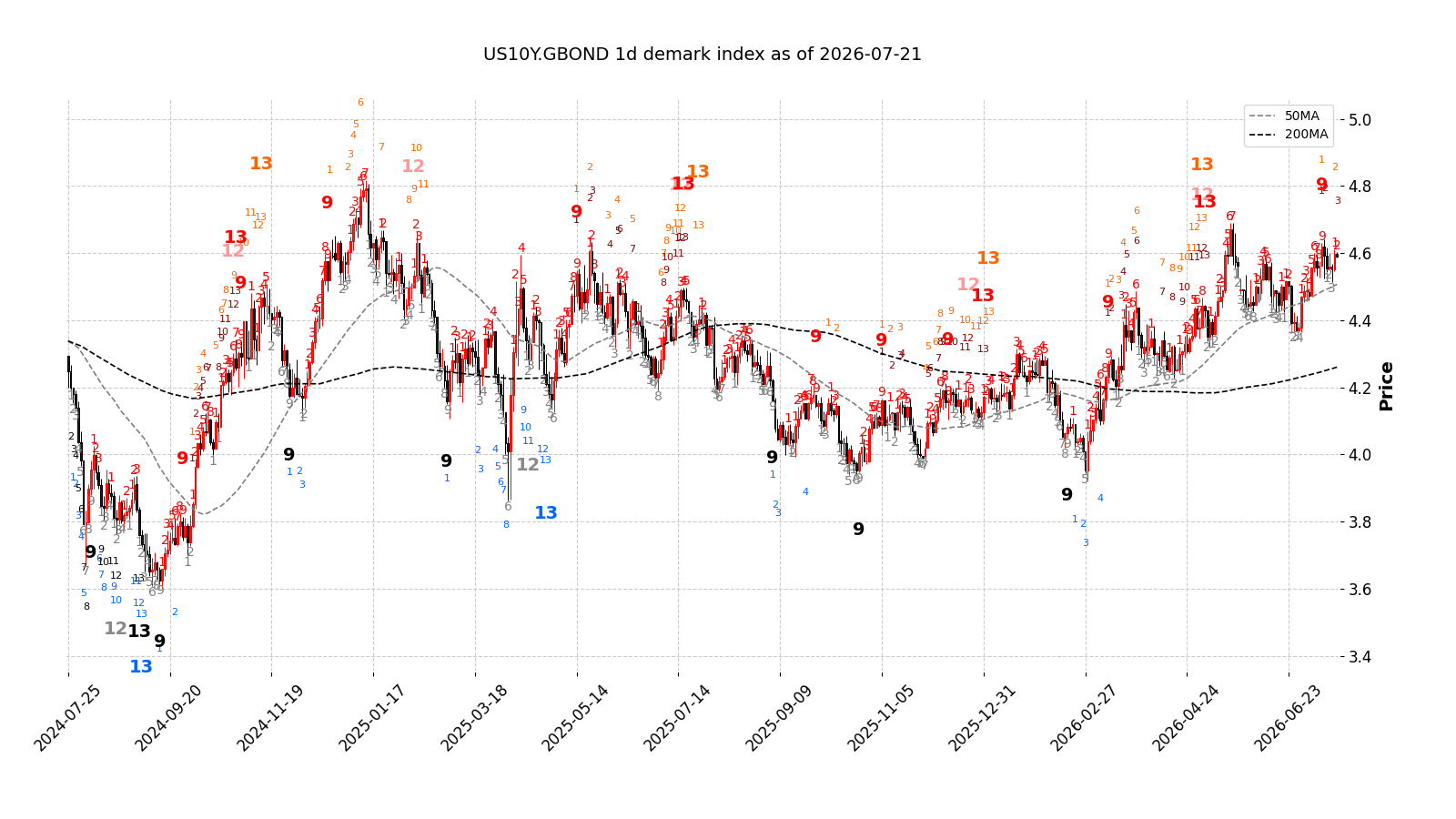
Risk-off demand is the clearest Treasury driver in the summaries: a reported 17 bp decline in the 10Y yield accompanied a sharp Nasdaq selloff, as concern over AI investment and debt sustainability revived Treasuries’ safe-haven role. Persistent energy inflation and fiscal concerns pull the other way, leaving the rally vulnerable if oil-driven inflation or Treasury risk premia regain focus; no current yield levels are provided.
YIELD CURVE
The reporting points to relative-value dislocations rather than a clear directional curve move. Société Générale’s model flags the 2.5% 2045 note and 1.75% 2029 note as cheap, while the 4.375% 2038 note screens rich by 7.3 bp; the reported distortions support targeted butterfly or cash-bond relative-value trades, but do not establish a broad steepening or flattening signal.
INFLATION SIGNALS
Energy remains the main upside inflation risk: the summary cites Brent near $110/bbl and WTI near $101/bbl, alongside sharp increases in jet fuel and heating-oil costs. If sustained, those pressures could delay rate cuts and challenge the duration rally; the available material does not identify a new inflation-data release today.
CREDIT MARKETS
Stress is concentrated in AI infrastructure credit, not shown as a broad market spread move. CoreWeave’s bonds are described as selling off sharply amid leverage, liquidity, and AI-demand concerns, with potential spillover to debt-dependent technology issuers; no spread levels or evidence of broader IG/HY widening are provided. In high yield, Realty Income’s funding needs and leverage are flagged as risks, while the Australian issuer examples are company-specific investment theses rather than evidence of a sector-wide spread trend. Credit therefore shows pockets of stress, but the summaries do not establish whether it confirms the Treasury rally.
MACRO DRIVERS
- AI risk repricing: concerns about returns on infrastructure investment are pressuring risk assets and supporting safe-haven Treasury demand.
- Energy-driven inflation: high oil and fuel costs threaten to keep inflation persistent and limit scope for monetary easing.
- Fiscal and sovereign risk: France’s political instability and high debt are weighing on its sovereign outlook; U.S. debt and reserve-allocation concerns could add longer-run pressure to Treasury term premia.
- Cross-market divergence: reported Treasury strength contrasts with stress in French sovereigns and select AI-related corporate debt.
POSITIONING IDEAS
Bullish Duration
- Add duration tactically if AI-related equity and credit weakness broadens. A deeper selloff in technology risk assets or further deterioration in AI-infrastructure financing could extend safe-haven demand and pull intermediate Treasury yields lower.
Bearish Duration
- Fade the rally if energy inflation persists or fiscal-risk concerns intensify. A sustained move in crude near the reported levels, or renewed focus on U.S. debt and Treasury demand, could lift term premia and reverse part of the reported 10Y yield decline.
This content is for informational purposes only and does not constitute financial, investment, or trading advice. Always consult a qualified financial professional before making any investment decisions.
Daily Rates Pulse
RATES OVERVIEW
Hotter-than-expected CPI and a sharp rise in energy risk are the clearest rates drivers in the news flow. Treasury yields are described as near 5%, with the 10Y Treasury yield cited at about 5.1%; the summaries provide no precise intraday move. Brent at $110/bbl adds an upside inflation risk that could keep duration under pressure.
INFLATION SIGNALS
The latest CPI report came in hotter than expected, reinforcing concern that inflation may remain persistent and limit scope for rate cuts. Brent at $110/bbl, amid Strait of Hormuz shipping attacks and other energy disruptions, raises the risk of renewed fuel and freight cost pressure; an easing of those risks would help unwind that threat. Corporate reports also point to margin pressure from elevated beef, fuel, and claims costs, though they do not establish a broad change in inflation expectations.
CREDIT MARKETS
The main financing signal is Strive’s $630 million perpetual preferred issuance at 15%. That unusually high coupon points to costly capital access for the issuer, but preferred equity is not a conventional high-yield bond-market spread signal. The news provides no meaningful IG or HY spread moves, broad primary-demand data, or rating actions, so credit cannot be judged as confirming or diverging from Treasuries.
MACRO DRIVERS
- Energy-supply risk: Shipping attacks around the Strait of Hormuz and strikes on Russian energy infrastructure have lifted Brent to $110/bbl, adding an inflation-risk premium.
- Sticky inflation: Hotter CPI reduces confidence that inflation is moving toward target and could keep policy restrictive.
- Fiscal and duration supply concerns: The Treasury summary flags rising debt and sustained yields near 5%, but gives no new auction or supply-demand data to quantify today’s impact.
POSITIONING IDEAS
Bullish Duration
- Trigger: A de-escalation in shipping and energy risks that pulls Brent down from $110/bbl. Lower fuel-cost pressure could ease inflation concerns and support a rally in the 10Y Treasury.
Bearish Duration
- Trigger: Another upside inflation surprise or continued disruption to energy flows that keeps Brent near $110/bbl. That would strengthen the case for restrictive policy and leave duration vulnerable around current yield levels.
This content is for informational purposes only and does not constitute financial, investment, or trading advice. Always consult a qualified financial professional before making any investment decisions.
Daily Rates Pulse
RATES OVERVIEW
Risk-off demand lifted Treasuries as the technology selloff drove investors toward safe-haven duration. The 10Y Treasury yield was reported in a 5.06%–5.13% range, while TLT rose 1.37%; persistent inflation and oil-supply risks continue to limit the rally.
MONETARY POLICY
Fed hike expectations have fallen sharply despite strong inflation readings. Reports put October hike odds at roughly 13%–30%, down from 55% in one estimate, as ambiguous Fed signals encouraged a pause narrative. Abroad, markets are pricing nearly 75bp of further ECB tightening, while resilient UK growth has strengthened expectations for another Bank of England hike.
INFLATION SIGNALS
Inflation data point to renewed cost pressure: PPI rose 1.3% month over month and 6.3% year over year; import prices climbed 1.1% month over month and 8.1% year over year. CPI was reported at 3.7% year over year, with core inflation at 2.6%. Geopolitical risks to energy infrastructure and elevated diesel costs add upside risk, complicating the case for Fed easing even as risk aversion supports Treasuries.
CREDIT MARKETS
High-yield AI credit is diverging from the Treasury rally. Spreads on AI-related high-yield bonds and data-center project finance widened 25bp in two days to 360bp over Treasuries, reflecting higher funding costs and doubts about speculative AI financing. No meaningful investment-grade spread or issuance data were provided.
MACRO DRIVERS
- Flight to quality: The technology and semiconductor selloff redirected flows into long-duration Treasuries.
- Energy-driven inflation risk: Geopolitical threats to oil infrastructure and elevated diesel costs could keep price pressures persistent.
- Fiscal and term-premium risk: Large deficits and reduced foreign demand remain structural headwinds for Treasuries, particularly at the long end.
- Credit-market stress: Wider AI high-yield spreads signal tighter financing conditions even as government bonds rally.
POSITIONING IDEAS
Bullish Duration
- Add duration if the technology selloff broadens and Treasury inflows strengthen. The trigger is further deterioration in risk appetite, which could extend the safe-haven bid and push the 10Y yield lower.
Bearish Duration
- Fade the rally if incoming inflation data stay hot or energy prices rise further. A fresh upside surprise in CPI, PPI, or diesel costs could revive Fed tightening expectations and push yields higher.
This content is for informational purposes only and does not constitute financial, investment, or trading advice. Always consult a qualified financial professional before making any investment decisions.
Daily Rates Pulse
RATES OVERVIEW
Hot September CPI drove a sharp Treasury selloff and a higher-for-longer repricing: headline inflation reached 3.7% and core 2.6%, while the 10-year Treasury yield rose to 5.278% and the 30-year yield moved above 5.59%. Reports also describe a late-stage failure of yields to extend their rise on the inflation news, so the session’s strongest signal was the initial hawkish repricing, with a possible exhaustion signal emerging afterward.
YIELD CURVE
The reported move pushed long yields to multi-decade highs, but the 30-year yield’s limited follow-through and reversal after CPI raised the possibility that the long end had already priced much of the inflation shock. Sources characterize the curve as flattening or inverted, but provide no 2-year yield or curve-spread levels to quantify that move. The key inflection is whether long-end yields resume climbing or confirm the reported “news failure.”
MONETARY POLICY
The hot CPI print shifted market pricing toward further Fed tightening: the reported probability of an October hike rose to about 44%, with December hike odds near 93%. Fed officials Austan Goolsbee, John Williams, and Thomas Barkin reinforced the hawkish tone, with Goolsbee calling inflation “unacceptable” and Williams and Barkin leaving further hikes open. Abroad, the ECB is seen nearing a pause, the BoJ is signaling caution on another near-term hike, and Singapore’s MAS held policy steady while keeping future tightening possible.
INFLATION SIGNALS
September CPI ran above forecasts, with headline inflation at 3.7% year over year and core at 2.6%; gasoline prices rose 9.1% month over month. The combination of hotter core inflation and an energy shock challenges the disinflation narrative and keeps the Fed’s easing path in question. Escalating attacks on Saudi energy infrastructure add an upside risk to oil prices and inflation expectations, though no specific market-based inflation-expectation levels were provided.
CREDIT MARKETS
The clearest credit signal was idiosyncratic stress in high yield: CoreWeave’s 2032 bonds were reported below 80 cents on the dollar, yielding about 15%, alongside a 15% single-day equity decline. That points to investor concern about leverage and AI-infrastructure financing, but the summaries provide no broad high-yield or investment-grade spread moves to establish a market-wide trend. Investment-grade coverage described Galderma’s acquisition financing as consistent with preserving its rating; credit’s confirmation of the Treasury selloff is therefore limited to single-name risk, not broad spread evidence.
MACRO DRIVERS
- Sticky inflation and energy risk are keeping rate-cut expectations under pressure and raising the risk of further Fed tightening.
- Treasury volatility is weighing on duration-sensitive assets and complicating corporate financing and deal activity.
- Central-bank divergence is growing: the Fed remains hawkish, while the ECB and BoJ are signaling greater caution.
- AI-credit risk is becoming more visible through CoreWeave’s stressed unsecured bonds, even as demand for some asset-backed AI financing persists.
POSITIONING IDEAS
Bullish Duration
- Trigger: Treasury yields fail to make new highs after the hot CPI print, confirming the reported “news failure,” or incoming growth data weaken. That would support a tactical long-duration position, with the 30-year yield’s reversal as an early signal to watch. Treat this as a conditional trade: inflation and Fed pricing remain adverse to duration.
Bearish Duration
- Trigger: Another firm inflation reading or a sustained oil-price shock from Middle East disruption pushes Fed hike pricing higher and renews upward pressure on long yields. That would favor staying short duration, particularly if the 10-year Treasury yield breaks above its reported 5.278% level.
This content is for informational purposes only and does not constitute financial, investment, or trading advice. Always consult a qualified financial professional before making any investment decisions.
Daily Rates Pulse
RATES OVERVIEW
Inflation risk and expectations of restrictive Fed policy dominate, with the 10Y Treasury yield reported at 5.23–5.26% and the 30Y Treasury yield at 5.55–5.60%. Elevated energy and geopolitical risks add to the pressure, while weaker U.S. activity signals offer a counterweight; the market’s next major test is the upcoming CPI and PPI data.
YIELD CURVE
The reports describe the 10Y yield rising while the 30Y edged lower, implying a flattening move in the 10s30s segment. The curve remains positively sloped at the reported levels, but this divergence may signal that investors are weighing near-term inflation and Fed risk against weaker longer-run growth; no front-end yield move is provided.
MONETARY POLICY
Cleveland Fed President Beth Hammack argued for faster, incremental tightening, citing core inflation at 3%; markets were reported to price an 88% chance of a December hike. That hawkish signal conflicts with separate reporting that weaker economic surprises have revived expectations of a pause or cuts, leaving CPI and PPI as key catalysts for the rate path. Abroad, the ECB’s inflation-driven tightening stance is complicated by French fiscal stress, while UK rate expectations remain firm.
INFLATION SIGNALS
Reported U.S. inflation remains sticky, with headline inflation at 3.4% and core PCE at 3%. Geopolitical threats to energy shipping have lifted oil and gas prices, adding upside risk to inflation expectations; a hotter-than-expected CPI or PPI print would strengthen the case for restrictive policy and could push yields higher.
CREDIT MARKETS
There is no broad IG or HY spread, issuance, or default data to establish whether credit is confirming the Treasury selloff. Company-specific AI infrastructure news points to greater differentiation: Firmus’s withdrawn $5 billion IPO raises questions about MAAS Group’s exposure and contracted orders, while TeraWulf’s credit-backed lease structure was presented as a stronger counterparty-supported model. These developments indicate scrutiny of financing quality, not a market-wide spread signal.
MACRO DRIVERS
- Energy-supply risk: Houthi attacks and threats to the Strait of Hormuz could lift energy prices and inflation expectations.
- Fiscal and term-premium pressure: Heavy global borrowing needs and elevated U.S. debt concerns weigh on long-duration Treasuries; French fiscal stress is widening the OAT–Bund spread.
- Growth-policy tension: Weak U.S. economic-surprise readings and pressure on consumers support a duration bid, but sticky inflation and hawkish Fed signals limit it.
POSITIONING IDEAS
Bullish Duration
- Trigger: A softer-than-expected CPI or PPI print, or further deterioration in employment and consumer-credit data. That would challenge the December-hike pricing and could pull the 10Y Treasury yield lower; the reported negative economic-surprise reading adds support, though it has not yet displaced inflation concerns.
Bearish Duration
- Trigger: Hot CPI or PPI data, or another energy-price shock that lifts inflation expectations. That would reinforce Hammack’s case for faster tightening and could push the 10Y Treasury yield higher, particularly if markets add to the reported December-hike probability.
This content is for informational purposes only and does not constitute financial, investment, or trading advice. Always consult a qualified financial professional before making any investment decisions.
Daily Rates Pulse
RATES OVERVIEW
Inflation and energy risk, rather than a clearly documented intraday data surprise, dominate the rates backdrop. The supplied reports put long-dated Treasury yields above 5.3% and describe the 10Y Treasury as approaching 5.5%, with persistent inflation, higher oil prices, fiscal concerns, and hawkish Fed expectations weighing on duration. No specific session-on-session yield change is provided.
MONETARY POLICY
The Fed’s recent stance remains hawkish: the summaries say FOMC minutes showed unanimous support for a recent rate hike and leave further tightening in play. Market-implied odds are reported inconsistently, so the updates do not establish a reliable shift in the expected rate path; CPI and Fed Chair Kevin Warsh’s remarks are identified as the next catalysts. Abroad, expectations of faster BoJ tightening point to policy divergence, although no new decision is reported.
INFLATION SIGNALS
Oil above $105 per barrel, driven by geopolitical disruption and energy-supply concerns, adds upside risk to headline inflation and could keep Treasury term premiums elevated. The summaries cite an upcoming U.S. CPI consensus near 3.6% year over year for headline inflation, making a hotter print a potential catalyst for renewed tightening expectations; those figures are forecasts, not reported data. Corporate signals are mixed: PepsiCo’s lower EPS growth outlook and margin pressure suggest limited ability to pass through costs without hurting profitability.
MACRO DRIVERS
- Energy and geopolitical risk: attacks on energy infrastructure and uncertainty around U.S. support for Ukraine threaten supply stability and raise inflation risk.
- Fiscal and duration premium: elevated deficits and heavy long-end supply concerns compound the effect of high inflation expectations on long-dated Treasuries.
- Growth-policy tension: resilient growth supports higher-for-longer rates, while the cumulative drag of restrictive policy is raising concern about financial-sector and broader economic strain.
- Global divergence: expectations for faster BoJ tightening contrast with the Fed’s still-restrictive stance and may affect currency and carry-trade dynamics.
POSITIONING IDEAS
Bullish Duration
- A softer-than-expected CPI print could reduce the perceived need for another Fed hike and support a duration rally, particularly if oil prices also retreat. The trigger is a clear downside surprise in headline or core inflation.
Bearish Duration
- A hotter CPI print or another leg higher in oil could reinforce higher-for-longer pricing and push long-end yields higher. The trigger is inflation data that exceeds expectations, especially if Fed commentary validates the risk of further tightening.
This content is for informational purposes only and does not constitute financial, investment, or trading advice. Always consult a qualified financial professional before making any investment decisions.
Daily Rates Pulse
RATES OVERVIEW
The dominant signal is higher for longer: long-end U.S. yields are at multi-decade highs, with the 10Y Treasury at 5.218% in the cited selloff. The front end still reflects an October pause but a 25bp December hike; upcoming CPI/PPI and oil-driven cost pressure are the main catalysts for repricing.
YIELD CURVE
The available detail points to pressure in the long end, but does not provide comparable daily moves across maturities. There is not enough information to confirm a session-level steepening or flattening signal.
MONETARY POLICY
U.S. pricing described in the news points to a pause in October followed by a 25bp Fed hike in December. Hot CPI/PPI or further oil gains could reinforce that path; softer data could challenge it.
In Europe, a December ECB hike is described as fully priced, but Citi sees French fiscal stress and financial-stability risks as grounds for an earlier pause. Its scenario implies a 50–75bp downward repricing of ECB rates relative to the Fed; this is an analyst view, not a confirmed policy shift.
INFLATION SIGNALS
Corporate cost pressures remain visible in fuel, food, freight, and labor: Delta cited a nearly $2bn fuel-cost increase, while PepsiCo, Chipotle, and Kraft Heinz face margin or outlook pressure from input costs and softer consumers. Persistent cost pass-through and firmer CPI/PPI would support the case for the Fed to keep rates restrictive and preserve December hike pricing.
MACRO DRIVERS
- U.S. inflation risk: Oil and corporate input costs leave the market vulnerable to an upside CPI/PPI surprise.
- European fiscal stress: France’s budget pressures could force the ECB to weigh financial stability against inflation control, widening policy divergence with the Fed.
- Growth and duration tension: Elevated yields weigh on rate-sensitive investment and valuations, while current real yields remain below the cited 2% long-run growth threshold.
POSITIONING IDEAS
Bullish Duration
- Trigger: softer-than-expected CPI/PPI, especially alongside easing oil prices. That could unwind some December hike pricing and support duration, with the 10Y Treasury a key focus after the cited move to 5.218%.
Bearish Duration
- Trigger: hotter CPI/PPI or another oil-led cost shock. That would strengthen the case for a December Fed hike and leave long-end yields exposed to further higher-for-longer repricing.
This content is for informational purposes only and does not constitute financial, investment, or trading advice. Always consult a qualified financial professional before making any investment decisions.
Daily Rates Pulse
RATES OVERVIEW
Higher-for-longer fiscal and inflation concerns remain the dominant rates driver, keeping Treasury yields near cycle highs. The 10Y Treasury retreated from a reported peak near 5.36% to roughly 5.22%–5.27%, with strong demand at the 30Y Treasury auction helping cap the long end; geopolitical de-escalation also lifted risk appetite and lowered oil prices.
YIELD CURVE
The reported decline in long yields against an elevated front end points to bull flattening, with the 10Y yield pulling back while short-term rates remain anchored by restrictive policy expectations. That move raises the risk of renewed inversion if long yields fall further, though persistent inflation and Treasury supply remain counterweights to a sustained rally.
MONETARY POLICY
The policy backdrop remains hawkish: reports cite a unanimous September Fed hike and expectations for another increase by year-end, but no new Fed communication today is identified. The curve’s retracement suggests some investors see the hiking cycle nearing a pause; Singapore’s MAS, by contrast, is expected to make a measured tightening adjustment to the SGD NEER band slope at its October review.
INFLATION SIGNALS
No fresh inflation release is identified. Reports continue to flag sticky underlying price pressure and elevated energy and industrial input costs, although today’s geopolitical de-escalation pushed oil lower—a near-term disinflationary offset. Persistent input costs would limit the scope for a durable Treasury rally and reinforce the Fed’s restrictive stance.
CREDIT MARKETS
Credit signals are mixed. Reports flag widening corporate spreads and greater distressed-debt risk, while the geopolitical risk relief supported broader risk appetite; without daily spread levels, the net move is unclear. In investment grade, heavy AI-infrastructure borrowing and strong demand for recent Treasury auctions indicate available funding, but large hyperscaler issuance adds duration and supply risk. In high yield, SoftBank’s reported bond sale and its leveraged AI spending plans raise issuer-specific concerns, while warnings about European telecom exposures point to selective sector risk. Credit is not clearly confirming the long-end Treasury rally; fundamentals and issuance risks remain a counterweight.
MACRO DRIVERS
- Fiscal supply and debt sustainability keep a premium in long-dated Treasuries, with the 30Y yield approaching 6% in reports.
- Strong auction demand has temporarily absorbed long-end supply and helped pull the 10Y yield back from its high.
- Geopolitical de-escalation improved risk appetite and lowered oil, but Middle East supply risks remain.
- Sticky inflation and restrictive policy keep the front end vulnerable to renewed hawkish repricing.
POSITIONING IDEAS
Bullish Duration
- Trigger: Sustained strong demand at long-dated Treasury auctions, alongside continued oil-price declines and softer growth signals. That combination could extend the 10Y yield’s retreat and support selective long-duration exposure.
Bearish Duration
- Trigger: A sustained move back above the 10Y yield’s reported 5.36% peak, particularly if inflation pressure persists or Treasury supply overwhelms auction demand. A break toward 5.5% would reinforce the higher-for-longer and fiscal-risk premium; keep duration risk concentrated at the long end.
This content is for informational purposes only and does not constitute financial, investment, or trading advice. Always consult a qualified financial professional before making any investment decisions.
Daily Rates Pulse
RATES OVERVIEW
Higher-for-longer remains the dominant rates theme. Persistent inflation risks, oil above $105/barrel, and a hawkish Federal Reserve have pushed the 10Y Treasury yield to roughly 5.32–5.36%, the highest level since 2002. Strong demand at the latest 10Y Treasury auction provides a counterweight, but fiscal concerns and geopolitical risk continue to pressure long-duration assets.
MONETARY POLICY
The Fed’s tightening signal remains firmly hawkish. Markets are assigning an 86% probability of another 25 bp hike by year-end, while the federal funds rate stands at 3.75–4.00%; the September FOMC minutes reinforced a higher-for-longer path rather than an imminent easing cycle.
The Hungarian National Bank halted rate cuts but offered no forward guidance despite raising its 2027 inflation forecast to 3.1%. That policy ambiguity is weakening the forint and raising the risk premium on Hungarian assets. The ECB and BoE also retain tightening risk as energy prices rise, although Europe’s fiscal and growth fragility limits policy flexibility.
INFLATION SIGNALS
U.S. inflation data are mixed: Truflation shows headline inflation moderating to 2.26%, but energy and wage pressures keep underlying risks elevated. The escalation in the Middle East has pushed crude above $105/barrel, raising the probability of a renewed supply-driven inflation shock and delaying any prospect of Fed easing.
Corporate signals point to persistent cost pressure. Heineken cited a 9.2% decline in beer consumption since 2019 following price increases, while PepsiCo, Chipotle, and insurers continue to report margin or claims pressure from labor, input, and replacement costs. The inflation impulse is shifting from demand resilience toward energy and supply-chain risk, a combination that is particularly adverse for long-duration bonds.
CREDIT MARKETS
Investment-grade credit remains supported by strong demand for high-quality yield, with selected investment-grade corporate bonds offering yields above 6%. However, the scale of AI-related borrowing is becoming a material supply and leverage risk: AI-linked issuance has risen to 25% of corporate deals, with technology companies potentially raising as much as $1.2 trillion by 2027.
High-yield credit is showing greater stress than Treasuries. CDS spreads have widened sharply for AI-linked borrowers, including Oracle at 261 bp, SpaceX near 16%, and Nvidia above 7%. Applied Digital’s $6.4 billion debt load against $2.9 billion of cash and a $221 million quarterly loss reinforces the concern that infrastructure spending is running ahead of near-term cash-flow generation.
Credit is diverging from the safe-haven bid in Treasuries: strong demand remains for high-grade issuers, but widening high-yield CDS and increasingly complex financing structures signal deteriorating risk appetite beneath the index level. A slowdown in AI investment or weaker-than-expected returns could convert concentrated leverage into a broader high-yield spread shock.
MACRO DRIVERS
- Energy-driven inflation: Middle East tensions have lifted crude above $105/barrel, raising stagflation risk and reinforcing the Fed’s restrictive stance.
- Fiscal and supply pressure: Elevated government borrowing and heavy corporate issuance are adding duration supply while investors demand higher compensation at the long end.
- Geopolitical safe-haven demand: Conflict risk supports demand for U.S. Treasuries, but the inflationary effect of energy disruption is limiting the rally.
- Global policy divergence: The Fed remains hawkish, while the MNB’s lack of guidance is undermining the forint and European central banks balance inflation risks against weak growth and fiscal stress.
POSITIONING IDEAS
Bullish Duration
- De-escalation in the Middle East: A sustained decline in crude below $100/barrel would reduce near-term inflation risk and could pull the 10Y Treasury yield back from the 5.3% area.
- Financial-stability shock: A move toward or through 5.5% in the 10Y Treasury yield, combined with widening credit spreads or bank stress, could trigger a flight to quality and support long-duration U.S. Treasuries.
- Weakening growth data: A material slowdown in consumption, business investment, or labor markets would challenge the market’s higher-for-longer pricing and support duration, particularly after the recent repricing.
Bearish Duration
- Further oil escalation: A sustained move above $105/barrel, especially toward $110, would raise inflation expectations and increase the probability of another Fed hike, favoring short duration.
- Another hawkish Fed repricing: Confirmation that the Fed intends to keep the federal funds rate above 4% for longer, or renewed pricing for a year-end hike, would place further upward pressure on the 2Y yield and the 10Y Treasury yield.
- Persistent fiscal and corporate supply: Continued heavy Treasury issuance alongside record AI-related corporate borrowing could push the 10Y Treasury yield toward 5.5%, particularly if auction demand weakens from current strong levels.
This content is for informational purposes only and does not constitute financial, investment, or trading advice. Always consult a qualified financial professional before making any investment decisions.
Daily Rates Pulse
RATES OVERVIEW
Higher-for-longer remained the dominant rates theme, with persistent inflation concerns, surging oil prices, and hawkish Fed expectations driving the 10Y Treasury as high as 5.34% and the 30Y yield to 5.71%, both multi-decade highs. A strong 10-year auction then reversed part of the move, pulling the 10Y yield back toward 5.27% and signaling that real-money demand remains strong despite elevated term yields.
YIELD CURVE
The curve experienced a modest, broadly based rally after the auction: the 2Y and 10Y yields fell approximately 2 bps, while the 30Y yield declined about 1 bp. The move was therefore closer to a parallel shift than a meaningful steepening or flattening signal; the curve remains elevated and shaped by restrictive-policy expectations. Strong indirect demand—80.34% of the 10-year allocation, with a 2.77 bid-to-cover ratio—provided a temporary floor under duration.
MONETARY POLICY
The Fed’s September minutes reinforced a hawkish, higher-for-longer bias, keeping the possibility of another rate hike before year-end in focus despite some moderation in core inflation. Market expectations remain sensitive to any language indicating that officials require clearer evidence of disinflation before easing. Elsewhere, the RBI raised its repo rate 25 bps to 5.50% and shifted from neutral to “calibrated tightening,” with markets pricing the risk of two additional hikes through February.
INFLATION SIGNALS
Energy markets delivered the clearest fresh inflation impulse: Brent crude moved above $101 and WTI approached $90 as Strait of Hormuz attacks and Gulf Coast storm risk threatened supply. Gasoline at $4.36 per gallon and diesel at $6.30 point to renewed headline-inflation pressure, while sticky services inflation and wage growth continue to complicate the Fed’s path toward easing. The G7’s planned release of 100 million barrels of crude and diesel is a policy response to the shock, but failure to stabilize fuel prices would reinforce the risk premium in long-end yields.
CREDIT MARKETS
Corporate credit news was mixed but lacked a clear broad-based spread signal. BASF provided a constructive investment-grade fundamental example, with earnings growth and sustainable-products expansion supporting credit quality, while SpaceX’s proposed $30 billion investment-grade debt issuance highlighted investor concern over the growing acceptance of speculative, capital-intensive business models within the high-grade market.
The reported sell-off in SpaceX bonds suggests that institutional demand is not unconditional, particularly where leverage and future cash flows are aggressive. Credit is therefore less supportive than the Treasury auction: high-quality sovereign demand remains firm, but skepticism toward ambitious corporate leverage points to selective rather than indiscriminate risk appetite. No meaningful high-yield spread, default, or downgrade trend was reported.
MACRO DRIVERS
- Energy-supply risk: Strait of Hormuz attacks and Gulf Coast storm exposure lifted crude prices and revived stagflation concerns.
- Fiscal and sovereign risk: The OAT/Bund spread widened to 150 bps, reflecting global risk aversion and renewed concern over French political and fiscal uncertainty.
- Global policy divergence: The Fed remains restrictive while the RBI has begun a tightening cycle; higher U.S. yields are pressuring emerging-market currencies, including the rupee.
- Supply absorption versus valuation: Strong Treasury auction demand supports duration at high yields, but the market still prices persistent inflation and restrictive policy.
POSITIONING IDEAS
Bullish Duration
- Buy duration on evidence that the 5%–5.3% long-end zone attracts sustained real-money demand. Follow-through from strong 10-year auctions, declining yields despite heavy supply, or weaker growth data would support a move lower in the 10Y yield and a rebound in TLT.
- A softer Fed message or clearer disinflation would be the cleanest catalyst. Confirmation that officials are done hiking, combined with easing core inflation or falling oil prices, would challenge the higher-for-longer premium embedded in the 10Y and 30Y.
Bearish Duration
- Stay short duration if oil remains above $100 and inflation expectations reaccelerate. Persistent energy disruption, renewed fuel-price gains, or evidence of second-round wage and services pressure would keep the Fed hawkish and could retest the 10Y yield’s 5.34% high.
- A weak Treasury auction or firmer Fed minutes would extend the selloff. Deteriorating bid-to-cover ratios, lower indirect participation, or explicit guidance that another hike remains likely would push the long end higher and favor the front end over long-duration exposure.
This content is for informational purposes only and does not constitute financial, investment, or trading advice. Always consult a qualified financial professional before making any investment decisions.